
From small unknown towns to underrated cities to picture-perfect natural spaces, there’s no shortage of hidden gems in northern Italy, the queen of exquisite food & wine, regal architecture, art, history, and remarkable natural landscapes.
Fully enjoying what the regions in this area have to offer will take years upon years (I have taken many trips to northern Italy yet still only scratched the surface), so many towns and cities can serve as a base to explore it, but if you’re planning a trip and want to get off the beaten path, the following places will surely provide some memorable moments.
*I try to keep the information on this blog as updated as possible, but I still recommend consulting the latest prices, opening hours, and other details on the official website of each site, hotel, and tour, as well as checking the updated public transport routes and timetables. I share my personal experience and cannot guarantee yours.
*This post may contain affiliate links from which I earn a commission. As an Amazon Associate, I earn from qualifying purchases. For more info, read my disclosure and disclaimer. This post may show pop-ups.

Northern Italy off the Beaten Path: Friuli-Venezia Giulia Region
Laghi DI Fusine
By Natali from She’s Abroad Again
When most people think of Italy, they think of charming cobblestone streets, cities full of history, and stunning beaches. However, northern Italy is home to some majestic mountain ranges full of hidden gems.
You will find the fascinating Laghi di Fusine at the foot of Mangart massif in the Julian Alps, right between the borders of Italy, Austria, and Slovenia. Their location makes them easy to visit even on a day trip from Zagreb, Croatia.
These two alpine lakes of glacial origin are a perfect place for a relaxing day in nature, even if you are not a sporty person!
Two lakes, Lago di Fusine Inferiore and Superiore are connected by a circuit trail approximately 2km long. Both lakes are stunning and have crystal-clear water, so make sure to hike the path connecting them.
You can hike the circuit trail in 45 minutes, but don’t be in a rush. The path is fairly flat, and there are benches along the way to sit and enjoy the view. The second lake is a starting point for many hikes, so if you are a hiking lover, remember to bring proper equipment!
Alternatively, rent a small boat on the first lake and head out for a unique and relaxing activity.

Hidden Gems in Northern Italy: Region of Lombardy
Ponte DI Legno
By Isabella from Boundless Roads
If you are looking for a typical Italian mountain town with wooden houses, flowery windows, and cobblestone roads, Ponte di Legno is one of the cutest villages that you can visit in the north of Italy.
Located in the Val Camonica among the Italian Alps in Brescia province, it is easily reachable either from Brescia or Milan by direct bus. However, it’s recommended to rent a car to explore the beautiful surroundings.
The name Ponte di Legno means wooden bridge in Italian. In fact, this pretty town is named after an old bridge crossing the rivers Frigidolfo and Narcanello right in front of their merging point, creating a beautiful postcard-worthy scene.
Ponte di Legno is renowned among Italians and foreigners alike as a great ski resort in winter and a hiking destination in the summer, but it’s also loved by those who are less sporty.
In fact, the pretty town also offers spa services, delicious coffee shops and wineries where you can hang out and relax, easy trails with spectacular panoramic views, and great restaurants where you can try the delicious local cuisine.
The outdoorsy will love the 42 slopes among Ponte di Legno, Tonale, Presena, and Temu, all connected and suitable for all levels for great winter holidays in the snow.
In the summer, you will find many trails that allow you to walk for days, if you are up for it, and sleep in the free cabins scattered around the mountains. All the trails are very well mapped and marked.
Also, mountain biking has become huge in the past few years, and you can rent all the necessary equipment in local shops.
Whether you decide to have a summer holiday or an Italian winter getaway, whenever you go, you will have a blast in Ponte di Legno.

Trezzo Sull’Adda
By Sarah from Mukikapup’s Travels
Trezzo sull’Adda is a small Italian town you might easily miss, but it’s a mere 19 miles (30.5 km) from Milan. It’s a UNESCO World Heritage Site with a lot to offer, including unique travel photography opportunities!
You can reach Trezzo sull’Adda by public transit and see the sites on foot or by bike.
A trip to Trezzo sull’Adda should include the Visconti Castle, a 14th-century castle with a fortified bridge, as well as Villa Gina, a 17th-century villa and the location of the Adda Nord Regional Park.
Along with these sites, you should definitely take a walk through the workers’ village of Crespi d’Adda, a textile company town and present-day UNESCO site that serves as a well-preserved example of towns built for company workers in the 19th and 20th centuries.
On your visit, you’ll see the workers’ houses, town amenities like public wash-houses, a clinic, a school, a theater, and the hydroelectric power station.
The church and the castle were also part of the village, and the overall geometric layout and brick exteriors of the building design are part of the charm, not to mention the location in the quaint river valley surrounded by nature and amazing views.
The village has a visitor’s center, and you can find cafes and restaurants both in Crespi d’Adda and Trezzo sull’Adda.

Moltrasio, Lake Como
By Zoe from Together In Switzerland
For a beautiful hidden gem in Northern Italy, take your time near Lake Como to visit Moltrasio.
Located on the western side of the lake, this commune is officially part of the Lombardy region of Italy, close to the border of Switzerland.
There are a few significant historical places in Moltrasio, such as the Church and Piazza San Martino, which dates back to 1207, and the Church of Sant’Agata, dating back to 1197.
The second church mentioned was once used as a local hospital to help those in need during the plague.
There are also a few stunning viewpoints from where you can look towards the opposite villages of Brunate, Torno, Lemna, Molina, Villa Roda Roccabruna, Blevio, and more.
To enjoy the lake view with a bite to eat, head to The Moltrasio Bay restaurant. They provide delicious Italian dishes with tables on their terrace area.
Fun fact: You can find up to 30 drinking fountains in Moltrasio, so you won’t be short on filling up a water bottle on a hot day. Many of the fountains date back to the 19th century when locals would use them for fresh water as well as for washing clothes near the bigger washhouses.

Pescallo
By Joanna from The World in My Pocket
Pescallo is a lovely place just off the very popular Bellagio, on Lake Como.
Whilst most tourists will swarm the streets of Bellagio, Pescallo remains relatively empty, and you can explore it at your own pace, without any of the crowds. It is, without a doubt, one of the most beautiful towns on Lake Como.
To reach Pescallo, you have to walk towards the end of Bellagio and spot the narrow alley bordered by stone walls, going uphill. After a five-minute walk, you will start descending into Pescallo and spot the first colored houses covered with ivy.
Pescallo is quiet, small, and very pretty. The main square opens up to the lake, with a few benches overlooking it.
There are many boats and small yachts anchored in the bay. The water here is so clear that you can see the stones at the bottom of the lake.
If you are adventurous, you can rent a kayak or a paddleboard and explore this area of the lake at your own pace.

Imbersago
By Shev from Shev Strolls
Tucked away along the river Adda near the town of Imbersago, you will find the Villa D’Adda Reaction Ferry.
This small river shuttle was allegedly designed by Leonardo Da Vinci, but that’s not the only thing that makes the ferry special.
As you watch the boat make its way across the water, you will notice something peculiar….silence! The Leonardo Ferry does not have an engine!
The ferry is connected to a cable between either side of the river and special rudders underneath.
Every day, the ferry captain adjusts the rudders according to the river currents, and that is what pushes the boat and its passengers – up to 100 people and 5 cars – back and forth across the water.
The Villa D’Adda Ferry is accessible from the town of Imbersago in Lecco County. The boarding area has a lovely river walk and some tables to enjoy a riverside picnic.
Don’t let the gorgeous blue hues of the River Adda tempt you though – the currents are strong, and swimming is forbidden due to the danger of the water.
Villa Panza, Varese
By Katie from Katie Caf Travel
Villa Panza is a true hidden gem in the north of Italy and the Lombardy region. An 18th-century Italian mansion, it has been beautifully maintained and is now home to an extensive collection of contemporary fine art.
Villa Panza was bequeathed to the FAI: Fondo Ambiente Italiano, also known as the National Trust for Italy, in 1996.
FAI is a non-profit organization that aims to “take care of special places in Italy for the benefit of present and future generations”, and that’s certainly something they succeeded with Villa Panza.
In 2001 it re-opened as a modern cultural house and contemporary art museum.
The art collection at Villa Panza started in the 1950s when Count Giuseppe Panza owned the palace. He had an affinity for art and began amassing a collection that is still on display today in the modern-day museum.
Currently, you can see over 150 works at Villa Panza, spanning from contemporary artists like James Turrell, Robert Irwin, and James Flavin, as well as historical art pieces dating back to the Renaissance period.
Hidden Gems of North Italy: The Aosta Valley Region
Lago DI Brusson
Located in eastern Aosta Valley, the Brusson Lake is a stunning turquoise gem that must be on your itinerary. Surrounded by mountains and vast grass fields, it’s also an ideal place to enjoy a picnic, offering plenty of tables with benches and a big playground.
You’ll find more than enough parking, which is free if you’re not visiting in the peak season, as well as a few places to stay around the lake.
If you’re driving on the SR33 to get to Brusson, note that the road is very winding, but the views over this area you see along the way are completely worth it.
When you want to go back towards the central part of the region, consider driving south on the SR45 and then heading north again on the SS26 or the E25 highway.

Cascata Del Lenteney
Right between the town of Aosta and the Skyway Monte Bianco cable car, there’s an enchanting waterfall that connects to the beautiful Dora Baltea River.
Driving on the SS26 instead of the E25 highway, you’ll see it (and the cafe of La Cascata) on your left if you’re heading west, so cross the small bridge a few meters before it and park the car.
Apart from marveling at the scenery from the bridge, you can also take a short walk to see the waterfall up close (look for the trail signs near the cafe, which, by the way, makes excellent coffee and hot chocolate).
Even though the Aosta Valley boasts dozens of postcard-perfect natural spots, this one can easily be a highlight on your northwest Italy road trip.

Aymavilles
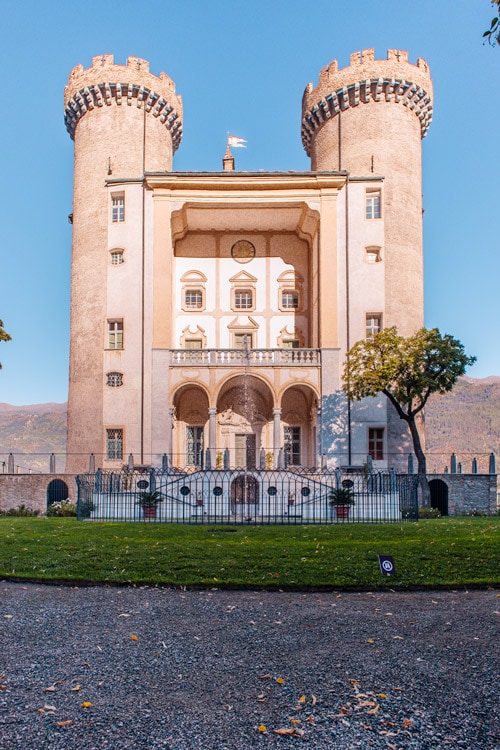
Aymavilles is a small town surrounded by vineyards and apple orchards, dominated by the gorgeous Aymavilles Castle.
The 4-tower castle was built in the 13th century for the noble Challant family, and today, you can explore its rooms and history for only 9 euros (you can buy tickets here).
Another visit-worthy stop in the town is the Les Cretes Winery, which was established in 1800. Set in a beautiful modern rural space, the winery welcomes you whether you just want to buy wine or have a tasting and a tour, which you can book here.
Pont D’aël
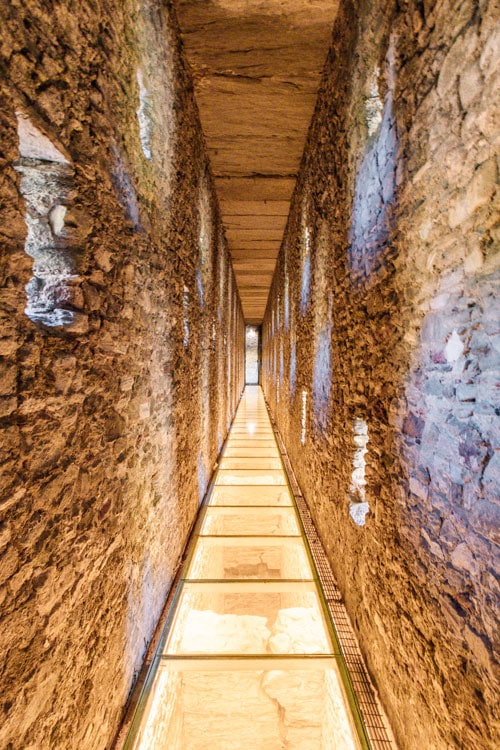
Situated only 4 km from the Aymavilles Castle, Pont d’Aël is a Roman aqueduct dating back to 3 BC.
Still visible is an inscription from that era, which says the aqueduct was privately owned and funded by a man named Caius Avillius Caimus from the wealthy Avilli family.
The landmark’s uniqueness becomes even more apparent when you see its surprising location amidst the natural scenery, its upper part, which serves as a bridge, and its covered passageway, which you can buy tickets to walk through (only 5 euros for adults).
Castle of Baron Gamba (Castello Gamba)
There’s no shortage of castles and fortresses in Aosta Valley, but Castello Gamba is an unusual one, considering it’s not medieval and was only built in the 20th century.
Comissioned by Baron Carlo Gamba, the estate-like castle is surrounded by a vast park you can wander around, and it now houses a museum of modern and contemporary art.
It also offers beautiful views of the valley, so even if you’re not visiting the museum, it’s worth adding a quick stop here.

Passerella Panoramica of Pré-Saint-Didier
The quaint town of Pré-Saint-Didier is known for its natural thermal springs, but did you know it’s also home to a stunning lookout point?
After a 5-minute drive from the center and another 10-minute walk from the parking lot, you’ll get to the Passerella Panoramica, which provides breathtaking views over this part of the valley.

Lo Copafen
Aosta Valley is famous for producing fontina cheese, and plenty of local dishes allow you to try this amazing local product, including polenta concia, fondue, and risotto alla Valdostana.
Those who want to visit a cheese cellar and buy high-quality fontina can head to the farm and shop of Lo Copafen, located a short drive from the iconic Fenis Castle.
The welcoming owners let you see the cellar for free, but be sure to try and purchase some goods before heading to your next stop.

Read more about Aosta Valley:
Hidden Gems in North Italy: Region of Veneto
Bassano Del Grappa
By Daniel from Urban Abroad
With so many unique things to do in northern Italy, it can be tricky to know which ones to pick, but if visiting a medieval town located at the foot of Veneto’s Alps sounds hidden enough, then Bassano del Grappa makes the perfect place to see.
Being located just 1 hour and 20 minutes away from Venice, this town can give you a world-apart experience from the city of canals and bridges. It’s known locally for its Ponte Vecchio bridge, which you can walk along and admire the beautiful scenery over the river and the mountains.
You quickly start to realize there is something adorable about this town. When it comes to food to try, you have to sample baccalà mantecato (creamed cod), and during the springtime, the mouthwatering risotto with DOP white asparagus.
Some of the best things to do in Bassano include a stroll around the spirited Italian piazzas, which are elegantly filled with bars and traditional restaurants.
Then there is the Poli museum, where you can discover everything about Grappa, a local fragrant, grape-based Italian brandy.
Also, don’t miss the Sturm Palace, a place where you can get an insight into the ceramic production that is local to the town and famous throughout Italy.
To get to Bassano from Venice, just take the regional, direct train from Venezia Santa Lucia station.

Riviera Del Brenta
By Dhara of It’s Not About the Miles
One of the most unique day trips from Venice you can do is the Brenta River cruise from Venice to Padua. You can do the cruise in the reverse direction as well.
Along the Brenta River, you will find some stunning Venetian villas – there are more than 50 villas along the banks of the river! Many of them were built in the 15th and 16th centuries as holiday homes for wealthy Venetians.
One of the most beautiful villas along this stretch of the river is Villa Pisani in Stra. Today an art museum with an impressive collection, the villa has played host to many royals. Its gardens are renowned, with a well-preserved maze and a swimming pool.
Also in Stra, you can visit the Villa Foscarini Rossi, now a museum of shoes old and new.
The Villa Widmann is an 18th-century home that belonged to a family originally from Persia. The frescoes inside are must-sees, and the gardens are worth strolling as well.
Near Mira, you will find La Malcontenta or the Villa Foscari. Designed by famous Renaissance architect Andrea Palladio, this villa is part of the UNESCO World Heritage Site – “City of Vicenza and the Palladian Villas of the Veneto.” The interior features stunning frescoes.
Borghetto Sul Mincio
Located roughly 14 km (8.7 miles) south of Lake Garda, the riverside village of Borghetto is a Northern Italian hidden gem you cannot miss.
Its medieval landmarks and streets, combined with the surrounding natural scenery, make it irresistibly enchanting.
You’ll be greeted by the 14th-century fortified Ponte Visconteo, charmed by the old water mills dotting the hamlet’s picturesque center and mesmerized by the views of the Mincio River and the entire valley.
You should also check out the Church of San Marco Evangelista, visit the nearby Scaliger Castle, and try local tortellini called Nodo d’Amore (‘The Love Knot’), which, interestingly, are connected to a Romeo-and-Juliet-like love story legend.

Hidden Gems of Northern Italy: Region of Piedmont
Intra, Lake Maggiore
Adjacent to the town of Verbania, where many travelers visit the Villa Taranto Botanical Gardens, you’ll find the adorable Intra.
Sitting on the western shore of Lake Maggiore, this town makes a great stop on a road trip when you just want to grab some lunch or gelato and enjoy the lake views.
In a couple of hours, you can walk along its promenade (Lungolago di Intra), admire the Basilica di San Vittore, and roam the colorful alleys and hidden courtyards.

Cannobio, Lake Maggiore
A stone’s throw away from Italy’s border with Switzerland is the medieval lakeside town of Cannobio.
While it’s not a place with a lot of landmarks, it still offers quite a few things to do and see, including its weekly market, several churches, cobbled alleys, and a beautiful promenade overlooking Lake Maggiore.
You can also unwind at the town’s beach, Lido di Cannobio, located a few minutes away from the center. If you want to stay here, the area is home to plenty of camping sites, B&Bs, and hotels.
Avigliana
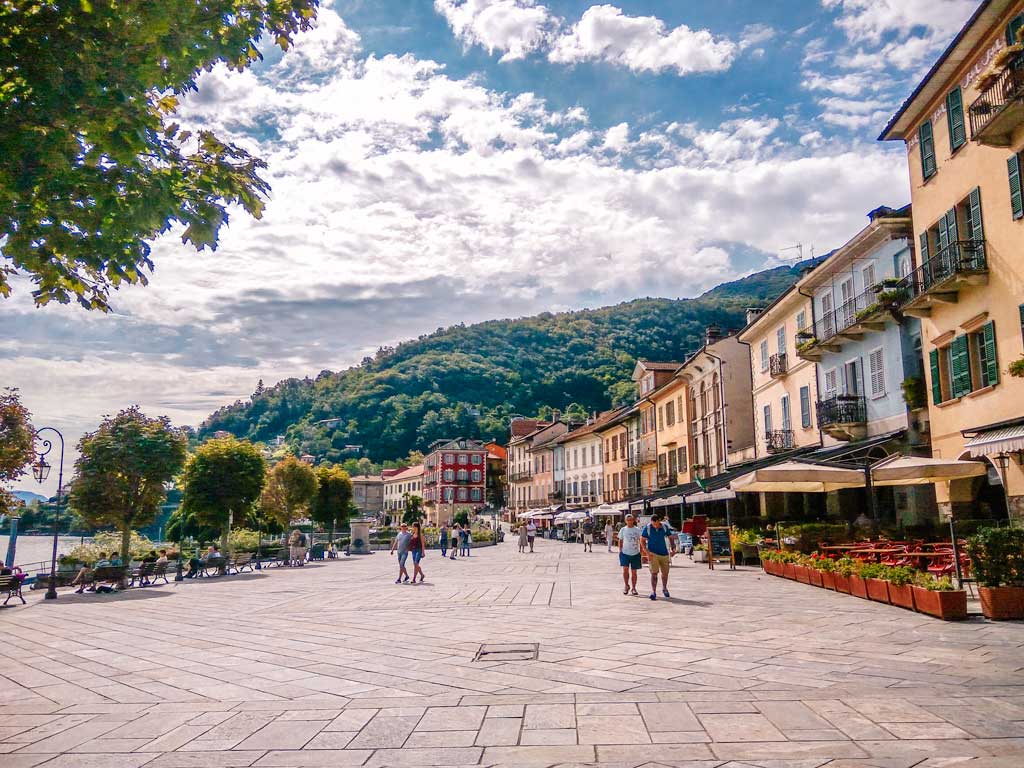
Only half an hour from Turin by car or train, not too far from the famous abbey Sacra di San Michele, is the lovely town of Avigliana, with origins tracing back to the 6th century.
Apart from roaming its tiny yet charming historic center, overlooked by the ruins of its castle, you can also visit the nearby Natural Park of the Lakes of Avigliana.
The two lakes are surrounded by walking and cycling trails, sailing centers, restaurants, and beach bars. Since it’s a natural park, it is also known for its flora and fauna, including different types of birds, frogs, and even turtles.

La Morra
By Olivia from Livguine
In the heart of the Piedmont wine region is one of the most spectacular hidden towns in Northern Italy – La Morra. Built in the Roman era, this town can be traced back to at least the 12th century.
Nestled up high on a hill, the drive to La Morra is truly beautiful as you pass fields and fields (and fields) of vineyards. This town is one of the most important Nebbiolo growing regions, from which, of course, the famed Barolo wine comes.
When in the heart of Barolo land, wine tasting is a given. There’s a lot of really good wine to be drunk here, and one of the best places to stock up on some affordable bottles is the Cantina Comunale di La Morra.
Other things to do include a stroll through the beautiful winding streets all the way up to the most stunning view over the whole Langhe region from Piazza Martiri!
Plus, don’t miss a walk through the vineyards to discover the Barolo Chapel. Make sure you have your camera, you’re going to want to snap lots of pics!
Enjoy a long lunch or dinner at one of the many excellent restaurants in town and indulge in the local cuisine. Visiting this part of northern Italy in October or November is particularly good for white truffle fans!

Orta San Giulio, Lake Orta
An often-overlooked charming place that will take your Italian lakes road trip to a whole new level is Lake Orta. Although it’s much smaller than Garda, Como, and Maggiore, it’s not going to disappoint.
Amongst the few small towns dotting the lake’s shores are Pella, Omegna, and Ronco, but if there’s one you cannot miss, it’s Orta San Giulio.
From the lovely Piazza Motta to the historic center’s enchanting cobbled alleys to the scenic views seen from the Sacro Monte di Orta, beauty is all around.
It’s also possible to stay at Villa Crespi, a 19th-century villa turned into a 5-star hotel and restaurant.
Last but not least, Orta overlooks a tiny islet, Isola San Giulio (home to the 12th-century Basilica di San Giulio), to which you can take a short boat ride.

Venaria Reale
The small town of Venaria Reale is located roughly 10 km (about 6.2 miles) away from Turin and is one of the best day trips from the Piedmontese capital thanks to the top landmark it’s home to – the Palace of Venaria (Reggia di Venaria Reale).
Along with other magnificent royal residences of the House of Savoy in the region of Piedmont, the 17th-century Baroque palace is a UNESCO World Heritage Site.
Commissioned by Duke Carlo Emanuele II, the palace is a must-see spot that boasts lavish interiors, lovely landscaped gardens, and surrounding Alpine scenery.
One of its most stunning rooms/halls is the Great Gallery, an architectural masterpiece known for its intricately detailed ceiling and strategically placed windows.
If a tour is not enough and you’re looking for a unique experience, opt for a meal at the palace’s Michelin-star restaurant.

Read more about Turin:
- Is Turin worth visiting?
- Things to do in Turin
- 3-day Turin itinerary
- Turin travel tips
- Cafes in Turin
- Turin chocolate guide
- Where to stay in Turin
- Turin in winter
- Hidden gems in Turin
- Turin or Milan
Secret Spots in Northern Italy: Region of Trentino-Alto Adige/Südtirol
Lake Resia
By Paul from Paulmarina
Lake Resia, also known as Reschensee, is located in Val Venosta, South Tyrol, in Northern Italy, right next to the Austrian border. What makes it so special is the bell tower in this turquoise lake.
The lakes in the area were turned into a hydroelectric dam, and in the process, the locals were relocated. What was left was the 14th-century bell tower right at the entrance to the new village of Curon (Graun im Vinschgau).
It’s a protected historical monument, and therefore it was left as a reminder, turning the mountain lake and tragic story into a mysterious place.
The backdrop of the snow-capped mountains and peaceful valley also makes it one of the most stunning places for you to visit in the Italian Alps.
The area is also known to be great for summer and winter sports and is famous for its stunning castles, ruins, and medieval abbey.

Antholz Valley
By Lori from Travlinmad
In the South Tyrol region is the stunningly beautiful Antholtz Valley, one of the best places to visit in northern Italy that remains mostly undiscovered.
This hidden gem goes by several names. In Italian, it is the Valle Di Anterselva, but because it’s only 9 kilometers from the Austrian border, you’ll most often hear it referred to in German as Antholzertal.
The lush valley neither looks nor feels like what you’d most often think of as Italy. Surrounded by mountains with the Dolomites nearby, this valley is a mecca for alpine hikers, and in the winter months in northern Italy, for cross-country and downhill skiing.
You won’t find a lot of tourists here. What you will find are charming small villages, dairy farms, and friendly locals who insist they are “Italian in passport only“.
There is much to see and do in the Antholz Valley. You can hike through incredible scenery around Lake Antholtz, hike to the alpine huts during the summer and winter, and visit the World Biathlon Center, where Olympic-class biathletes train.
The Germanic influence here is strong and is reflected in the hearty Alpine-style foods like schnapps, schnitzel, and tummy-filling dumplings.

Lake Tenno
North of Lake Garda, not too far from the town of Riva del Garda and the Varone Waterfall, a gorgeous lake and a medieval hamlet are waiting to be discovered.
With only 750 meters in length, Lake Tenno is a small yet utterly beautiful must-see spot for nature lovers.
Its vibrant color will surely put a smile on your face, and you can enjoy it by taking a walk around it, having a picnic, and even hopping in for a quick swim.

Borgo Medievale DI Canale DI Tenno
A stone’s throw away, you’ll find Borgo Medievale di Canale di Tenno, a tiny 13th-century village with a whole lot of rural charm that still keeps its original urban layout.
Its narrow cobbled alleys lined with flower-adorned stone houses are a delight to explore, taking you centuries back.
It was abandoned for a few decades after World War I and got the attention it deserved thanks to the artist Giacomo Vittone who immortalized it in his paintings.
Tenno’s Casa degli Artisti (House of Artists) is a museum dedicated to him, hosting exhibitions, workshops, and other events.

Trento
By Lyubomira from Bulgarian On The Go
Trento is nestled along the banks of the Adige River, seemingly tucked away from the touristy crowds. It’s one of those hidden gems in Italy that isn’t often on people’s travel lists, but once you come here, its charisma might make you want to come back.
The town is located in the beautiful region of Trentino-Alto Adige. The closest airports are in Verona (about a 1-hour drive), Bergamo (2 hours), and Venice (2 hours). From these places, you could either take a train or a bus to Trento.
An interesting fact is that Trento was awarded the Alpine Town of the Year in 2004. It also often ranks highly among Italian cities for quality of life and standard of living.
Trento is very popular among students who come here to study from all over the country, and it’s also one of Italy’s wealthiest and most prosperous cities.
The beauty of small towns is that they can be easily explored on foot. The same goes for Trento, especially if you’re staying in the town center.
There are so many things you can do in Trento – from wandering around the old town and visiting the beautiful Castel del Buonconsiglio, the most important castle in the region, to taking the cable car to the small town of Sardagna and enjoying the view over Trento from there.
If you’re traveling with kids or just interested in nature and science, here you’ll find MUSE – an interactive museum of science that can keep you occupied for a couple of hours.

Bolzano
By Lyndsay from The Purposely Lost
Easily considered a hidden gem in northern Italy, Bolzano is often overlooked because it’s not located near one of Italy’s main international airports.
However, this small city in the South Tyrol region has a lot to offer visitors who want to explore the Italian countryside.
Located inside the Dolomites mountain range, surrounded by lush green valleys, it has a fantastic city center and a unique blend of Italian and Austrian/German culture.
The region was part of the Holy Roman Empire for about 1,000 years and officially became part of Italy toward the end of World War I.
It’s home to several museums, including the South Tyrol Archeological Museum (Museo Archeologico dell’Alto Adige / Südtiroler Archäologiemuseum), which features artifacts dating back more than 5,000 years, as well as Ötzi, a Neolithic glacier mummy from the Copper Age.
The city is an excellent choice to base yourself on if you want to go hiking, skiing, snowmobiling, or sledding from Bolzano in winter. During Christmastime, it’s home to one of the largest Chriskindlmarkt in Italy.

Merano
By Gabi from Under Flowery Sky
Merano is a tranquil and picturesque town lying at the border between Italy and Austria, and its bilingual character speaks about its history. It is a wellness destination with the alluring invite of the South-Tyrolean mountains.
You will also be enticed by the historical attractivity that brought many artists and scientists. Some of them include Franz Kafka, Ezra Pound, and Princess Sissi, the most notable visitor. In the 13th century, Merano was also the capital of the County of Tyrol.
Merano is the botanical paradise where floral sculptures play their tune. You will also adore the pristine charm that belongs to the Summer and Winter Promenade.
The Gilf Promenade gives the torch of beauty to the Tappeiner Promenade, which opens the doors to scenic mountains in the embrace of Mediterranean plants. The cable car to Monte di Merano stands in the middle.
The colorful streets of Merano will bring you unforgettable joy. The historical Kurhaus building holds an elegant venue for congresses, balls, and concerts.
The Gardens of Castle Trauttmansdorf will simply enchant you as it was with Sissi. It was her holiday residence and now the loveliest gardens in Italy. The remote charm of the Meranese hills will give additional value.

Map of Northern Italy’s Hidden Gems
Access the map here.
Tip: After accessing the map, you can also open it on your Google Maps app. Simply open your app, tap the ‘saved’ icon at the bottom, scroll down and tap the ‘maps’ icon, and choose the MyMaps map you want to see (you can do the same on your computer).
Other Italy Guides
Read more about Italy:
- Hidden gems in southern Italy
- Hidden gems in Milan
- 4 days in Milan
- Road trips from Milan
- Things to do in Milan in the rain
- Day trips from Milan in winter
- Things to do in Milan in December
- Best places to visit in central Italy
- 7-day Rome-Florence-Venice itinerary
- Italy in winter
- Best Italian road trips
- Travel quotes about Italy
- Romance novels set in Italy
- Gifts for Italy lovers
Were you inspired by North Italy’s hidden gems? Read:

היי אור,כיף לקראו את המאמר
שמי מריאן ואני טסה עם בעלי למילנו ב17.7 לחודש כדי לברוח מהחום בארץ ולשקט נפשי.
אני ציירת ומתכוונת לצייר לאורך התקופה.
היינו רוצים לשכור איזה בית קטן בכפר ציורי ומסביר פנים,ורצוי לא תיירותי.
אין בעיה להתרחק ממילנו למשהו שווה
אשמח להצעות אם את מכירה
בתודה
מריאן
היי מריאן! כיף לשמוע!
אם אתם אוהבים טבע ופחות תיירים הייתי נוסעת לכיוון עמק אאוסטה שהוא חלומי (מוזמנת לקרוא את הפוסטים עליו פה בבלוג). מאוד אהבתי גם את הכפרים באזור האגמים אבל ביולי אני מאמינה שהם כן יהיו עמוסים.