
If you’ve gotten to know me a bit, you know how much I love traveling to the Spanish capital. I’ve heard some people say that ‘there isn’t much to do and see there,’ and I was baffled because you can find plenty of famous landmarks in Madrid, as well as museums, beautiful neighborhoods, amazing culinary and nightlife scenes, and so much more.
So if you like sightseeing but are not entirely sure what Madrid has to offer, here are more than twenty visit-worthy spots.
*I try to keep the information on this blog as updated as possible, but I still recommend consulting the latest prices, opening hours, and other details on the official website of each site, hotel, and tour, as well as checking the updated public transport routes and timetables. I share my personal experience and cannot guarantee yours.
*This post may contain affiliate links from which I earn a commission. As an Amazon Associate, I earn from qualifying purchases. For more info, read my disclosure and disclaimer. This post may show pop-ups.

Quick Suggestions for Your Trip
Top experiences in Madrid:
1. Skip-the-line Royal Palace tickets (daily visits are limited and a specific reservation time slot is required)
2. FREE walking tours of Madrid
3. Tapas and wine tasting tour in the unique literary quarter
4. A combo ticket to the Prado, Reina Sofia, and Thyssen-Bornemisza museums
Highly-rated famous and lesser-known day tours from Madrid:
1. Segovia and Toledo, must-visit UNESCO cities
2. Toledo and windmills of Consuegra, Cervantes’ inspiration for Don Quixote
3. Cuenca, an intriguing historic city
4. Guadarrama National Park, including the Castle of Manzanares el Real
Highly-rated accommodations in Madrid:
1. Woohoo Rooms Boutique Sol (mid-range), located a stone’s throw away from the central Puerta del Sol (or any other of the Woohoo Rooms locations)
2. Oriente Palace Apartments (mid-range/luxury), uniquely decorated and situated right next to the Royal Palace
3. 7 Islas Hotel (boutique) situated a stone’s throw away from Gran Via
Famous Landmarks in Madrid, Spain
Royal Palace
Starting with the obvious, the number one Madrid landmark you should visit is the 18th-century Royal Palace, the official residence of the Spanish Royal Family in the city and the largest royal palace in Europe that’s still functioning.
Though you can marvel at this Baroque beauty from the outside, I highly recommend touring the palace to see its jaw-dropping luxurious rooms and visit the Royal Armory, which boasts a collection of the personal arms of the Kings of Spain.
The daily visits to the Royal Palace are limited, so get your ticket in advance.
You can either book a guided tour or purchase a ticket for an unguided visit with a specific timeslot.
Some people can also visit the palace for free (read about it here).
Fun fact: The palace is also home to the Royal Quartet – a set of two violins, a cello, and a viola – all created by Antonio Stradivari around 1700. Along with another cello, they also form the Stradivarius Palatinos, the only complete Stradivarius string quintet in the world!

Almudena Cathedral
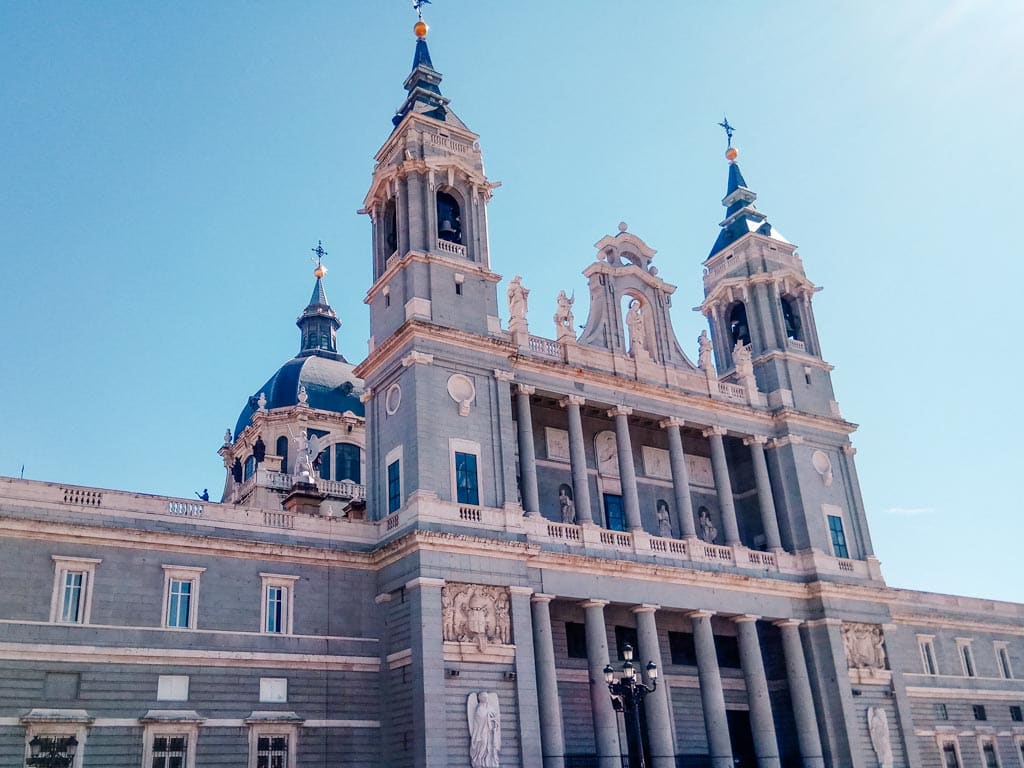
Next to the Royal Palace, you’ll see the Almudena Cathedral, one of the most important religious buildings in Madrid. It took over 100 years and six architects to construct it until it was finally completed in 1993.
You can also visit its crypt and a small museum from which you’ll get to the cathedral’s dome (offering magnificent views of the palace).
Golden Triangle of Art
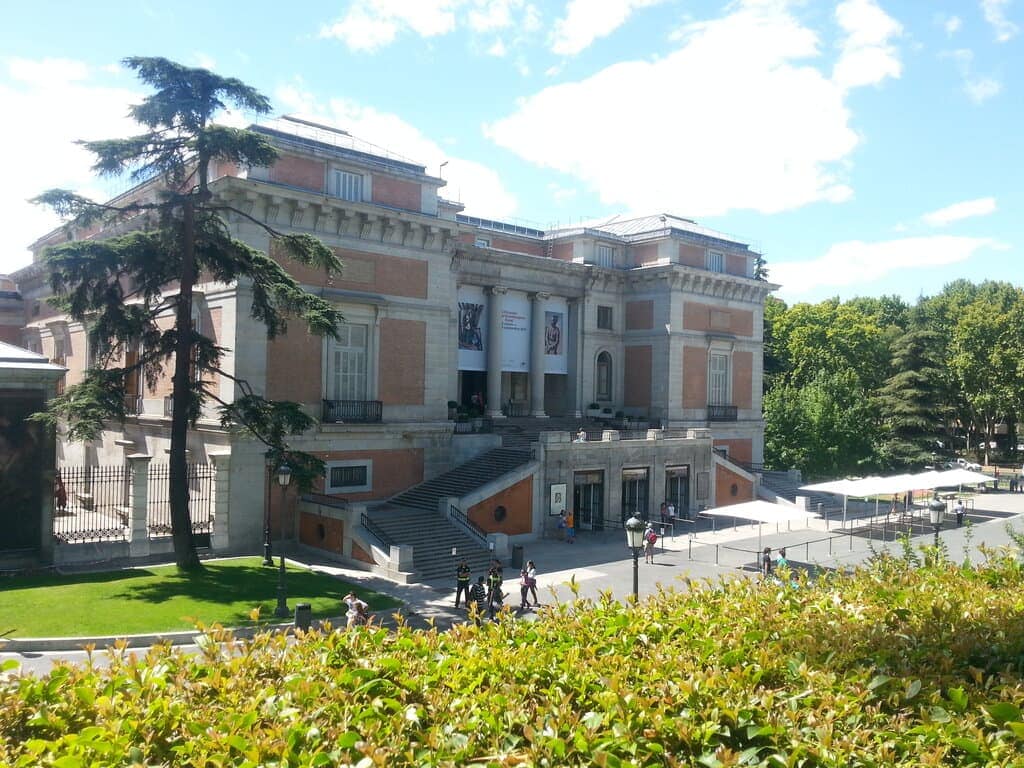
A trip to Madrid is not complete without visiting at least one of the museums that make up the Golden Triangle of Art.
You don’t have to be an art fanatic to be impressed with the pieces found in the internationally famous Prado, Reina Sofía (Museo Nacional Centro de Arte Reina Sofía), and Thyssen-Bornemisza.
Each one seems to be completing the other, and together they house one of the world’s finest collections of Spanish and European art from the 12th-20th centuries.
Amongst the museums’ most notable paintings, you’ll find Las Meninas by Velázquez (Prado Museum) and Guernica by Picasso (Reina Sofia Museum), but the list goes on and on.
Get your tickets to the Prado, Reina Sofia, and Thyssen-Bornemisza museums, or purchase a combo ticket that is valid for one year.
Note that on certain days and hours, admission is free (for more details, check out my full list of free museums in Madrid).
RETIRO PARK & ITS MONUMENTS
I wouldn’t normally consider a park a landmark, but Retiro definitely deserves that status, and in fact, it is a UNESCO World Heritage Site.
Not only did it belong to the Spanish monarchs for more than 300 years until the late 19th century, but it’s also home to quite a few visit-worthy points of interest.
From the notorious Crystal Palace to the Monument to Alfonso XII of Spain to the rose garden (La Rosaleda), you can spend hours exploring every nook and cranny of this gorgeous park.
Want to explore Retiro Park with a guide? Take this walking tour!


Puerta Del SOL
The most bustling square in Madrid, Puerta del Sol is literally located in the heart of the city and Spain.
It’s where you’ll find the plaque of Kilometro Cero, the point from which the distances of the national roads are measured, which is considered the geographical center of Spain. It’s also the starting point of the numbers of Madrid’s streets.
Other notable monuments in the square include the statues of Carlos III of Spain and El Oso y El Madroño’ (The Bear and the Strawberry Tree) – the symbol of Madrid’s coat of arms.
Puerta del Sol is also surrounded by countless shops, cafes, and restaurants, which means that it’s always vibrant and lively.
Plaza Mayor
Only a couple of minutes’ walk away from Sol, you’ll get to the stunning 17th-century Plaza Mayor, commissioned by King Felipe II and built during the reign of King Felipe III.
One of the buildings that make this European square so beautiful is Casa de la Panadería, which is decorated with colorful paintings of mythological figures from Madrid’s history.
The square has hosted countless events throughout the years, and today, it’s a lovely place to wander around and a great starting point to explore the neighborhood of La Latina.

San Miguel Market
The city’s most prominent indoor food market, Mercado San Miguel, is not just a fantastic place to stuff your face but also a legit historical landmark in Madrid.
The 100-year-old building still preserves its original cast iron structure and has become one of the top gastronomic spots in the city, receiving more than 10 million visitors a year.
The market mostly highlights Spanish cuisine, with stalls serving dishes and selling produce from across the country, from cheeses and seafood to croquetas and patatas bravas to desserts and more.
Puerta de Alcala
Did you know that Puerta de Alcala was the first Arc de Triomphe built in Europe after the fall of the Roman Empire? How cool is that?
Commissioned by King Carlos III in the 18th century, the Neoclassical gate was also one of the main entrance points to Madrid, which was still surrounded by walls at that time.
It’s impossible to miss this beautiful Spanish landmark as it’s situated near the northwestern corner of Retiro Park, only a couple of minutes away from the National Archaeological Museum.

Puerta de Toledo
Another triumphal-arch-like city gate worth mentioning is Puerta de Toledo. Dating back to the 19th century, it was built to commemorate Spain’s conquest of Napoleonic France in the Spanish War of Independence, honoring the return of King Ferdinand VII.
Royal Botanical Garden
I adore botanical gardens, and Madrid’s 18th-century Royal Botanical Garden does not disappoint. It was founded by King Fernando VI and moved to its current site by King Carlos III (Charles III of Spain).
The garden wasn’t always as beautiful as today, with quite a few decades of neglect in both the 19th and 20th centuries. But thanks to some restoration work, it has become a visit-worthy historical site in Madrid.
Its terraces and greenhouses are now home to thousands of ornamental plants, trees, flowers, and the largest herbarium in Spain. The garden truly is a wonderful addition to your Madrid itinerary and is conveniently located next to the Prado Museum.
An experience still on my bucket list is visiting the Royal Botanical Garden in December when it turns into a magical illuminated wonderland (at least that’s what it seems like in photos).

Caixaforum and Its Vertical Garden
Have you ever seen a vertical garden?
Well, you can find one in Madrid on the exterior wall of the adjacent building to the CaixaForum, a cultural center located on Paseo del Prado right across from the Royal Botanical Garden.
The center itself is actually a remodeled old power station, but it is the vertical garden, which boasts about 300 different plant species, that draws attention to this area that could have been easily overlooked without it.
Cibeles Palace
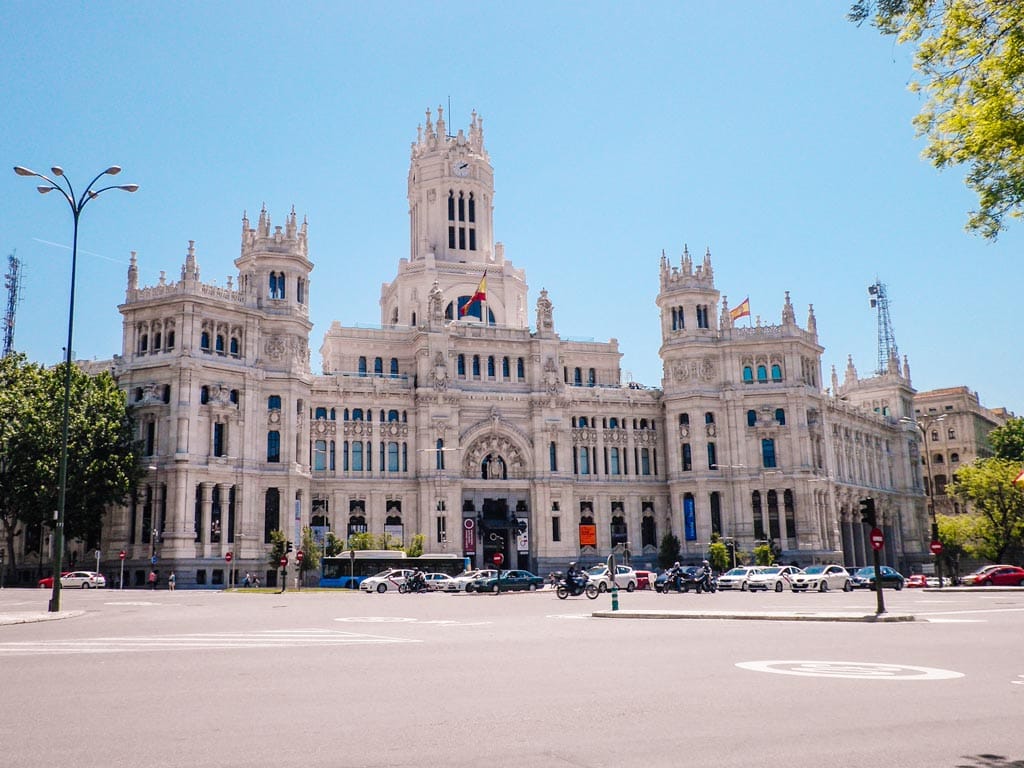
Not too far from Puerta de Alcala, you’ll find one of the most beautiful sights in Madrid – the Cibeles Palace (also known as the Palace of Communications).
Built in the early 20th century, the regal building is the former headquarters of the Spanish Post Office and the current seat of the Madrid City Council.
It also houses exhibition rooms, a gourmet restaurant overlooking Plaza de Cibeles (Cibeles Square), and even an observation deck where you can feast on magnificent views of the city.
To learn more about its history, architecture, and current use, you can take a guided tour inside the Cibeles Palace.
Royal Basilica of Saint Francis the Great
Commissioned by King Carlos III in the 18th century to replace a 13th-century Franciscan convent, the imposing Real Basílica de San Francisco el Grande boasts the largest dome in Spain and a marvelous collection of paintings by Spanish artists.
These works of art are housed in the basilica’s museum, which can be visited from Tuesday to Saturday. Be sure to consult its latest prices and opening times.
Atocha Railway Station
There’s something about train stations that fascinates me, and Atocha is definitely a unique one.
Not only does it connect Madrid with many other Spanish cities and towns, but it is also the city’s first railway station (dating back to the 19th century) and a beautiful Art Nouveau landmark.
After being expanded throughout the years, this huge complex also houses cafes, shops, and even an indoor tropical garden with more than 7000 plants (currently closed for renovation).
These are all found in the station’s old building, which is used for leisure, while the adjacent new building functions as the train terminal.

Segovia Bridge
Crossing the Manzanares River, the 16th-century Segovia Bridge is the oldest in Madrid. It was commissioned by King Felipe II and served as one of the main access points to the city.
It was built more than a millennium and a half later, but if you’ve ever visited Cordoba, it might remind you of its 1st-century-BC Roman bridge.
Metropolis Building
Even though it is “just” an office building, the Metropolis Building is one of Madrid’s biggest symbols.
It was built at the beginning of the 20th century for an insurance company, but it didn’t take long to realize that it should be treated as one of Madrid’s famous landmarks.
Thanks to its stunning Neo-Renaissance facade and iconic black and gold dome, it is one of the most photographed spots in the city and a must-see along the Gran Via avenue.

El Capricho Park
Being one of the greenest cities in the world (literally), Madrid is home to a mind-blowing number of gorgeous parks beyond the infamous Retiro.
Away from the city center (close to the airport), you’ll find a locals’ favorite, El Capricho Park, which is only open to the public on Saturdays and Sundays.
Commissioned in the 18th century by the Dukes of Osuna, it’s designed in such a way that different parts of it resemble English, French, and Italian gardens.
The vast park is also home to several photo-worthy monuments, including the Palace of the Dukes of Osuna, Plaza de los Emperadores, Bacchus Temple, and Casa de la Vieja, though it boasts plenty of other beautiful corners.
Circulo de Bellas Artes
You’ve probably stumbled upon photos of the views you can see from the terrace of the Circulo de Bellas Artes, one of the most famous buildings in Madrid, but this non-profit cultural institution has a lot more to offer.
Dating back to the late 19th century, it has exhibition rooms, concert halls, a cinema, a library, a restaurant (‘La Pecera’), and many other facilities. It also hosts countless cultural events all year round.
Of course, many people visit it for its rooftop bar and terrace, which cost €6 to access along with the exhibition halls.

Toledo Bridge
The Toledo Bridge (Puente de Toledo) is located in the area of the neighborhood of Madrid Rio. It is an 18th-century Baroque-style creation, known for its 9 arches and decorative statues of Madrid’s patron saints (San Isidro and Santa María de la Cabeza).
ARCO DE LA VICTORIA & FARO DE MONCLOA
Located near Oeste Park and the Museum of the Americas, Arco de la Victoria (also known as Puerta de Moncloa) is a triumphal arch built in the 1950s to commemorate the victory of the rebel side in the Battle of the University City during the Spanish Civil War.
Right behind it, you can’t miss the Faro de Moncloa (Moncola Lighthouse), which was constructed to celebrate the election of Madrid as the European Capital of Culture in 1992.
The 92-meter high tower has an observation deck that offers panoramic views of Madrid, and it only costs €4 to visit.

Liria Palace
Who said the Royal Palace is the only palace you can visit in Madrid? Let me introduce you to an 18th-century building that was the Madrid residence of a noble family named the House of Alba.
Touring the Liria Palace will give you a glimpse into its luxurious life, and you can even visit it for free on Monday mornings at 10 AM (but you have to reserve your spot in advance a week ahead).
You can also visit the palace throughout the week, but still, be sure to get your tickets in advance as you need to pick a specific time slot.
Church of Saint Manuel and Saint Benedict
Right across from the northern entrance to Retiro Park, you’ll find one of the prettiest churches in Madrid, the Church of Saint Manuel and Saint Benedict (Parroquia San Manuel y San Benito).
Built at the beginning of the 20th century, it is the only building in Spain constructed entirely in the Neo-Byzantine architectural style, and it’s easy to recognize its beautiful tower and red copper dome.

San Jerónimo El Real
Another easily recognizable church in Madrid is the 16th-century San Jerónimo el Real (Church of Saint Jerome the Royal).
Originally, it was a monastery of the Order of Saint Jerome, and the building standing today includes both remains of the old structure and restored parts.
What makes it unique is not only its gorgeous Gothic-style exteriors but also its historical significance.
You can pass by it and think it’s just another church, but during its years as a monastery, it was the place of the investiture of the Princes and Princesses of Asturias.
Debod Temple
One of the best sunset spots in Madrid, the Debod Temple is a curious landmark. Why is that? Because what does an ancient Egyptian temple from the 2nd century BC have anything to do with Spain?
Well, it’s not uncommon for countries to give gifts to one another, and Debod was a symbol of gratitude for Spain’s help in saving Egypt’s Abu Simbel Temples from the waters of the Aswan Dam in the 1960s.

Plaza de España
One of the largest, most beautiful squares in Madrid, Plaza de España is known for being home to the Cervantes Monument, dedicated to one of the world’s most influential writers.
Although Miguel de Cervantes, the infamous author of the Spanish novel Don Quixote, was born in Alcala de Henares, he lived and was buried in the Spanish capital (fun fact about Madrid – his remains were lost in the city for 400 years until they were found a few years ago and reburied!).
To commemorate him and his most prominent literary creation, the monument was erected in the 20th century. It includes sculptures of Cervantes, Don Quixote, and Sancho Panza, as well as a few more statues of other Cervantine characters.
Behind it, you’ll also see two of the city’s most distinct skyscrapers, Torre de Madrid and Edificio España.

Santiago Bernabéu Stadium
A football game is an incredible addition to any trip to Spain, even if you’re not a fan. My love for European football aside, the energy in the stadiums is unreal, and the overall experience is like no other.
But even if you don’t want to go to a game, you at least have to take a tour of Madrid’s most famous arena, Santiago Bernabéu.
As the home stadium of Real Madrid, one of the world’s most successful football teams, it’s difficult to put into words how culturally significant this place is.
To learn more about the history of Santiago Bernabéu, see the team’s cups and a collection of club memorabilia, and even get access to the dressing rooms, you have to take a tour inside the stadium.

Metropolitano Stadium
Let’s not forget that the Spanish capital is home to another amazing football team – Atlético Madrid.
Visiting their current stadium is actually still on my bucket list, but I was lucky enough to be at the older one, Vicente Calderón.
This team has the best fans, and attending one of their games was by far my favorite football experience. The energy was electrifying, and I even got a little emotional (not that it’s difficult to make me emotional).
I highly recommend going to a game, even if you’re not a football fanatic. Trust me, you’ll get addicted in no time. Otherwise, get a ticket to tour the stadium.
Map of the Most Famous Madrid Landmarks and Monuments
Click here to access the My Maps interactive map of Madrid and its landmarks.
Tip: After accessing the map, you can also open it on your Google Maps app. Simply open your app, tap the ‘saved’ icon at the bottom, scroll down and tap the ‘maps’ icon, and choose the MyMaps map you want to see (you can do the same on your computer).
OTHER MADRID & SPAIN TRAVEL GUIDES
Were you inspired by these famous Madrid monuments? Read more about the city:
- 2 days in Madrid
- Madrid in 4 days
- Alternative things to do in Madrid
- Madrid travel tips
- Where to stay in Madrid
- Madrid packing list
- Breakfast and brunch in Madrid
- Is Madrid worth visiting
- Cities and towns near Madrid to visit
Read more about Spain:

*Your emil address will not be published. By using this form you agree with the storage and handling of your data by this website