
Portugal has been attracting many visitors to both its mainland and its heavenly islands. However, most travelers are always heading to the southern parts of the country, chasing the sun and the perfect weather, and missing out on experiences like a northern Portugal road trip.
Northern Portugal is often unnoticed and less explored, though it is very rich in history and culture and is considered the place where Portugal was founded as a country, making it worth visiting.
It is absolutely marvelous, full of historical monuments, castles, palaces, religious complexes, and much more. Here’s how you can explore its highlights in a week with one of the best road trips in Portugal.
*I try to keep the information on this blog as updated as possible, but I still recommend consulting the latest prices, opening hours, and other details on the official website of each site, hotel, and tour, as well as checking the updated public transport routes and timetables. I share my personal experience and cannot guarantee yours.
*This post may contain affiliate links from which I earn a commission. As an Amazon Associate, I earn from qualifying purchases. For more info, read my disclosure and disclaimer. This post may show pop-ups.
Northern Portugal Itinerary Summary and Map
See the map of this road trip here.
Tip: After accessing the map, you can also open it on your Google Maps app. Simply open your app, tap the ‘saved’ icon at the bottom, scroll down and tap the ‘maps’ icon, and choose the MyMaps map you want to see (you can do the same on your computer).
Days 1+2: Porto (suggested hotel: Gallery Townhouse & Home).
Optional: On day 2, you can book a day tour to the scenic Douro Valley with wine tastings and lunch (other tours include a Douro River cruise) or a tour from Porto to the Peneda Gerês National Park.
Day 3: Guimaraes (suggested hotel: GuimaraesIN).
Day 4+5: Braga (suggested hotel: Hotel Dona Sofia or Burgus Tribute & Design Hotel).
Day 6: Barcelos (suggested hotel: RioVerde Agroturismo).
Day 7: Viana do Castelo + driving back to Porto.
Note: You can also visit Braga and Guimaraes with a guided day tour from Porto.
Northern Portugal Road Trip Days 1+2 – Porto
Porto is the biggest city in northern Portugal and is known for its rich culture and history wherever you go. It is located at the banks of the river Douro and follows its estuary until it reaches the Atlantic Ocean.
As one of the most beautiful cities in Portugal, Porto is captivating with its colorful riverside, incredible Port wine, and fascinating architecture accompanied by hand-painted tiles.
Highly-Rated Tours in Porto
- Day trip to the Douro Valley with wine tastings and lunch
- Free themed tours of Porto (there are 9 of them!)
- Food and wine tour
- Jewish heritage walking tour
- Live Fado show and wine

Carmo Church
The Carmo Church is probably the most visited religious building in Porto. It captivates its visitors with its richly decorated exterior with blue hand-painted tiles depicting various religious scenes.
The Carmo Church is for sure one of the most beautiful representations of Baroque architecture in the city.
However, a little-known fact is that the whole building is housing two separate religious buildings and a house. The house is known as Portugal’s tinniest residential building, and until the 19th century, people actually lived there.
The house separates the Carmo Church from Carmelita’s church so that there is no breach of the law from the 17th century (back in the days, it was forbidden for two religious buildings to be built side by side).
To explore further the churches, you can enter through the house’s door for a small fee. Inside, you will find the church’s tiny apartments, along with the tombs set underground.

Clerigos Tower
The Torre dos Clerigos is an architectural masterpiece in the heart of Porto. Built in the 18th century by an Italian architect, it has been the tallest building in Portugal for quite some time.
The Clerigos Tower is a religious complex, which consists of a church, a museum, and a tower.
The church inside the complex is simply fascinating, decorated with golden ornaments accompanied by pink or purple flags everywhere. There is a way to climb to its second floor and look at it from above.
In addition to that, you can continue to the museum, which holds the most captivating artifacts from the early period of the church. Eventually, climb up the tower and admire the beauty of Porto.
To enter the Clerigos Tower, purchase a ticket in advance online or at the ticket office for 6 euros, which is valid for the tower and the museum. The entrance to the church is free of charge.

Sao Bento Railway Station
If you did not have enough of the beautiful Azulejos (hand-painted tiles) at the Carmo Convent, head straight to Sao Bento railway station.
It is known for being covered by more than 20 thousand tiles depicting Portuguese historical events. Thus, it is no surprise that it was named the world’s most beautiful railway station, and indeed it is.
Cathedral of Porto
The Cathedral of Porto is a 12th-century astonishingly massive cathedral built on one of the hills of Porto.
It is known for its religious importance for the people of Portugal and its perfect combination of architectural styles – Gothic and Baroque.
Inside, the cathedral is as stunning as from the outside. However, to explore it deeper, you can check its cloisters and treasuries. To get to them, you will pass through the door on the right side of the cathedral, and go through a corridor covered in tiles.
In the end, you will find the cloister, which keeps the cathedral’s most precious artifacts. Entering the cloisters costs 3 euros, while the entrance to the cathedral is free of charge.

Ribeira
Ribeira is Porto’s colorful and authentic district, which was classified as a UNESCO World Heritage Site in 1996.
Nowadays, Ribeira is known for its incredibly chill and laid-back vibe, which can be felt as soon as you step into the district.
People at Ribeira are friendly, happy, and hospitable, which makes it a truly great place to enjoy.

Gaia
Ribeira is also known for being the gateway to the other side of Porto, Vila Nova de Gaia (simply known as Gaia).
By simply crossing the staggering Dom Luis Bridge, you will get to Gaia, which is known for its fine Port wine and cheap restaurant options; thus it is often chosen by tourists.
You’ll find dozens of wine cellars in Gaia, so you can either book a guided wine-tasting tour of several wineries or visit them independently.
To name a few, you can book a tour and wine tasting at the Calem cellar, Pocas cellar, Burmester cellar, and Graham’s Port Lodge (my favorite).
Other Things to Do in Porto
- Visit the magnificent Bolsa Palace.
- Visit Livraria Lello, one of the most stunning bookstores in the world.
- Look at the city from above at Miradouro da Vitória.
- Explore the famous Bolhão Market (which you can also explore with this free tour).
- Stroll through the beautiful Palácio de Cristal Gardens.
- Marvel the art at the National Museum Soares dos Reis.

Northern Portugal Road Trip Day 3 – Guimaraes
A north Portugal travel itinerary would not be complete without Guimaraes, which is considered to be the founding city of the Kingdom of Portugal. This is because the first king of Portugal, Afonso Henriques, was born there.
The city of Guimaraes is prominent for its beauty and authenticity, which can be seen while strolling through its narrow steep streets.
Most of the old streets in the city lead to the castles of Guimaraes, which belonged to its royal families. To enter all of the castles, you can buy a combined ticket.
Castle of Guimaraes
The Castle of Guimaraes is a staggering building made entirely out of solid rocks. The castle was built in the 10th century by the countess of Galicia, the Mumadona.
The main purpose of building the castle was to protect the people in the area from the advancing Vikings and Moors. Thus, the castle was built with tremendously high defensive walls and towers where archers were located.
Nowadays, the castle is quite empty, and there are not many artifacts inside of it. However, walking around its defensive walls is quite fascinating. Plus, it provides an incredible view of the Palace of the Dukes of Braganza.

Palace of the Dukes of Braganza
The Palace of the Dukes of Braganza was built in the 14th century by the Count of Barcelos. It was mainly used as a residence for the Portuguese Dukes until they abandoned the place in the 16th century.
The Palace is preserved well and sheds a lot of light on how people were living in the Middle Ages. Inside the palace, there is a huge courtyard surrounded by terraces from all sides.
In front of the entrance of the palace, there is a beautiful chapel, which is notable for its incredibly beautiful woodwork.
Every part of the chapel inside is made out of perfectly carved wood, from the benches to its ceiling, which is also painted and depicts various religious scenes.
On the first floor of the palace, there are numerous rooms, such as the carpenters’ room, the Banquet hall, and the Hall of Lost Steps. All of the halls were nicely decorated with woodwork arches and incredibly gorgeous hand-painted ceilings.
The most astonishing one is that of the Hall of Lost Steps due to its ceiling, which was designed to resemble the base of a boat.

Other Things to Do in Guimaraes
- Wander through the historic center.
- Visit the Archeological Museum Martins Sarmento.
- Admire the city’s old churches and cathedrals (like Nossa Senhora da Oliveira and Nossa Senhora da Consolação e Santos Passos).
- Take a free walking tour.
Northern Portugal Road Trip Days 4+5 – Braga
Braga is known for its religious complexes located on its hills near the city. It’s a part of the Camino de Santiago path and has been crossed by many saints in the past.
Bom Jesus Do Monte
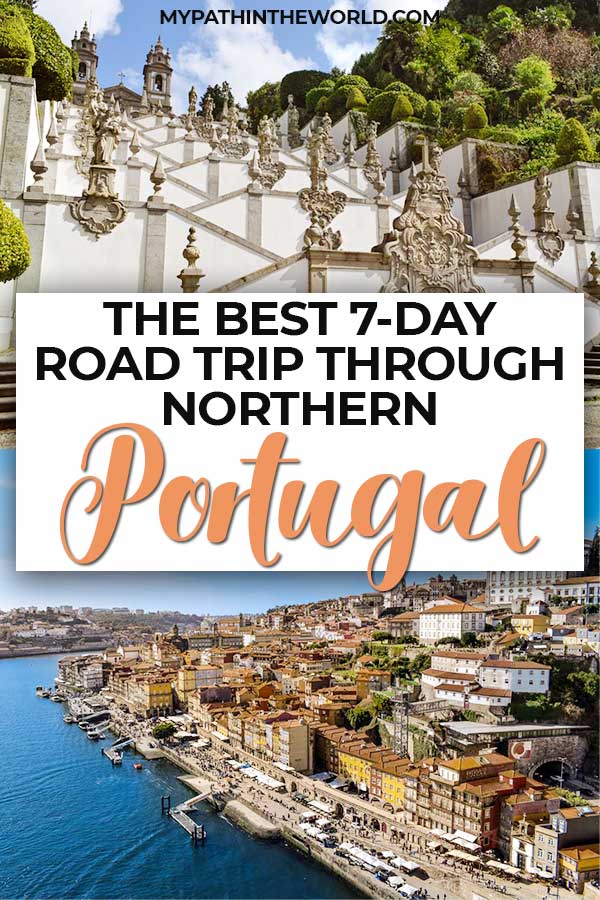
The most famous religious complex is the Bom Jesus do Monte, which was founded in the 14th century and finished at the beginning of the 18th century. It is known for its religious importance and beautiful Baroque architecture.
Along with that, it has an astonishing zig-zag stairway consisting of 577 stairs, which lead to the Basilica of Bom Jesus do Monte.
Along the way to the top, you would be stunned by the beautiful fountains representing various religious scenes. Some of them are the Wounds of Christ and the fountains of the Five Senses.
The religious complex is surrounded by a beautiful lush forest and is almost invisible. Above it, there is a private park with a huge pond, where many people take on a romantic boat ride.
The easiest way to get to Bom Jesus do Monte from Braga is by car or bus number 2 or 88.
Once at Bom Jesus do Monte, you can catch the funicular to the top or climb the stairway. You can also explore this amazing Portuguese landmark with a guide on this free walking tour.

Sameiro Sanctuary
Close to Bom Jesus do Monte and just 20 minutes away from it is the Sameiro Sanctuary (you can get there by bus number 88 or by car). It is another religious complex, built around the same time as Bom Jesus do Monte.
However, Sameiro Sanctuary has been dedicated to the Virgin Mary and is a lesser-known spot. Its grim Gothic architecture is quite uninviting, but once at the top, a beautiful view over the city of Braga is revealed.
This surely makes Sameiro Sanctuary worth a visit, plus the serene atmosphere it provides.
Dedicate one day to these two landmarks and the other to the city of Braga itself.
Other Things to Do in Braga
- Admire the city’s cathedrals and churches like the Braga Cathedral, São Marcos Church, and Holy Cross Church.
- Wander through the Santa Barbara Gardens.
- Visit the Biscainhos Museum.
- Take a free walking tour.
Northern Portugal Road Trip Day 6 – Barcelos
This small city in north-central Portugal is one of the most symbolic and culturally rich cities in the country. It is known for its symbol, Rooster of Barcelos, which is prominent for saving lives.
As the European legend goes, a pilgrim was accused of stealing sterling cutlery from a rich man. At the court, it was said that if a rooster crows 3 times, the pilgrim will be set free. So it happened, and the rest is history.
Palace of the Counts of Barcelos (Archaeological Museum)
The city of the Rooster is a charming city full of life wherever you go. At its entrance, there is the huge Palace of the Counts of Barcelos, which was destroyed by the earthquake in 1755.
Now, it is an open-air museum, which can always be visited. There is not much left of the palace but a couple of old stone crosses and tombs, which are rather grim.
Museum of Pottery
Inside the city, there is the Museum of Pottery, which is an absolute must-see for its incredible Portuguese pottery.
You can even participate in a workshop if you have the time. The price to enter the museum is 3 euros and is worth every cent.
Temple of the Senhor Dom Jesus Da Cruz
In the heart of the city, there is the Temple of the Senhor Dom Jesus da Cruz, which is famous for its round shape. It is the place where most of the locals gather and have celebrations.
However, the church is known for its beautiful frescoes and wall artwork, which is quite captivating.
The city of Barcelos is small, but so historically and culturally rich that it will be a shame for someone to skip out on it on their north Portugal road trip.
Other Things to Do in Barcelos
- Take a picture of the Galo de Barcelos (Rooster of Barcelos) statues scattered around the town.
- If you’re here on a Thursday, explore one of the oldest markets in Europe (and one of the largest in Portugal) – Feira de Barcelos.
- Look at the city from above the medieval Torre da Porta Nova (New Gate Tower).
Northern Portugal Road Trip Day 7 – Viana Do Castelo
Viana do Castelo is a city in Northern Portugal, which is quite close to the border with Spain. It has been inhabited since ancient times but became famous during the Age of the Discoveries.
Then, Viana do Castelo was one of the main ports in Portugal to welcome the voyagers from their trips. Along with that, the city’s port was protecting it against pirates or northerners who were trying to steal.
Nowadays, there is not much left of Viana do Castelo’s old city or port, but it is prominent for its beautiful church built on the top of the city.
Church of Santa Luzia
The church of Santa Luzia was built 80 years ago in the typical Portuguese Gothic style. Inside, the church is rather small and there are a couple of iconostases set on its walls.
However, you can climb to its top and overlook the whole area, which is truly astonishing. The church can be easily reached by using the funicular, which is close to the train station.
Igreja Da Misericordia
Although the city is rather small and there are not many things to see, you should visit the Igreja da Misericordia.
The church is known for its incredibly beautiful artwork and is covered in blue-painted tiles, which are decorated with golden ornaments.
Igreja da Misericordia is located in the old part of the city and is at the Praça da República, which is a small, well-preserved historic square.

How to Get around Northern Portugal
Car
Renting a car in Portugal is fairly easy and is surely the best way to explore the country.
A car might cost you anything between 20 euros to 100 euros per day, depending on your preferences, but you won’t regret going on a road trip in northern Portugal.
Stopping wherever and whenever you want, enjoying the music on the local radio, and snacking some road trip food – it doesn’t get any better than this.
In addition to that, Portugal has toll roads. The highway from Lisbon to Porto has boots installed for this purpose, but many roads and highways on the mainland do not have them.
Thus, this might require you to use a transponder device, which can be set by any rental company for about 2 euros per day. This device will surely save you lots of hassle along the way on your trip.
Compare the best car rental deals in one place on RentalCars.
Train
The railway system in Portugal is well-developed and maintained, which makes it quite reliable.
There is a way to make a connection everywhere, and you can even travel during the night. Traveling by train around northern Portugal is an easy, convenient, and sort of fast way to move around.
There is a train station in every city, even in small villages, which makes it one of the most reliable means of transportation. It’s also not expensive, and in fact, relatively cheap. You can catch the train for as little as 3 euros and travel further.
The biggest train stations in northern Portugal are Porto’s Porto Campanha and Sao Bento. From there you can hop on a train to anywhere in the country.
Other train stations with good connections are those in Braga and Guimaraes. You can use Omio (former GoEuro) to compare train and bus prices in one place.
Bus
Traveling by bus in Portugal is another way to get around the country and is also relatively cheap and fast.
The bus companies that operate in Northern Portugal are Rede Expressos and GetBus. Both of them provide regular transportation services for as little as 6 euros one-way.
To get a bus from Porto to any point in the north part of Portugal, you can go to Renex bus station at 24 de Agosto Metro station. There you will find their ticket office and check the destinations where they provide services.
It is good to note that they give a discount for people under 29 years old, so you can ask for that at the cash desk. You can also use Omio (former GoEuro) to compare train and bus prices in one place.

Author’s Bio
This northern Portugal road trip itinerary was written by Alex, a blogger at EarthOSea who has extensively traveled around Europe for the past 3 years.
She lived in Portugal in 2019 where she got more familiar with the Portuguese culture, traditions, and language.
Alex’s specialty is mainly in traveling in a sustainable and less harmful to the environment way. She is focusing more on ways to travel on a budget or money-for-value.
Along with that, she loves hiking and discovering uncharted islands, but she also loves staying at the beach with a book in hand.
Follow Alex on social media: Pinterest | Instagram | Facebook
Related Posts
You might also like:
- Road trip from Lisbon to Porto
- Hidden gems in Portugal
- How to visit Lisbon in 2 days
- Free things to do in Lisbon
- Lisbon packing list
- Kefalonia road trip
- Road trip from Carcassonne to Girona
- Best road trips in Spain
- Andalusia road trip
- Northern Spain road trip
- Best road trips in Italy
- Road trips from Milan
- Northern Italy road trip
- Northwest Italy road trip itinerary

*Your emil address will not be published. By using this form you agree with the storage and handling of your data by this website