
From palaces to monasteries to other intriguing monuments, the most famous landmarks of Portugal are truly a joy to discover.
Steeped in history, they unravel the journey of this amazing country from before it was born and all the way to the 21st century.
So if you’re eager to know more about them, here are 45+ famous Portuguese landmarks you have to add to your bucket list.
*I try to keep the information on this blog as updated as possible, but I still recommend consulting the latest prices, opening hours, and other details on the official website of each site, hotel, and tour, as well as checking the updated public transport routes and timetables. I share my personal experience and cannot guarantee yours.
*This post may contain affiliate links from which I earn a commission. As an Amazon Associate, I earn from qualifying purchases. For more info, read my disclosure and disclaimer. This post may show pop-ups.

Famous Landmarks of Portugal: Palaces and Castles
Pena Palace, Sintra
The UNESCO city of Sintra boasts quite a few palaces and castles, but the colorful hilltop Pena Palace is probably the most famous of all, receiving millions of tourists each year.
The 19th-century Romanticist castle-palace was built for King Ferdinand II and Queen Maria II, who acquired the remains of an old monastery to transform them into a luxurious summer royal residence.
Even though it has become an extremely popular attraction, there’s no denying that this place is unique. From its red, yellow, and purple exteriors to the diverse architectural elements to the vast park surrounding it, every nook and cranny of the palace is just magnificent.
As daily visits are limited, it is highly recommended to book tickets in advance.
If you want to tour multiple attractions in Sintra, you can get a discount when you purchase your tickets on the official website, depending on which sites you’re visiting.

Ajuda National Palace, Lisbon
A landmark that sometimes gets overlooked by travelers visiting Lisbon, the 18th-century Ajuda National Palace was built following the 1755 earthquake.
The earthquake did not only destroy the Ribeira Palace (the main royal residence in Lisbon) but also left King Jose I with a trauma that made him want to live high on the Ajuda hill.
Until the palace was complete, Napoleon invaded Portugal, and the Portuguese royal family had to escape to Brazil, so it was only in the 19th century that Ajuda became an official royal residence, home to King Luis I.
The stunning neoclassical palace is now opened as a museum where you can get a glimpse into the monarchs’ lives and marvel at an impressive collection of European decorative art.
Mafra National Palace
By Sarah from Life Part2 and Beyond
Less than an hour’s journey away from Lisbon is the lovely town of Mafra.
It’s a beautiful old town to explore, but your main reason to visit is that this is where you will find one of the largest and most extravagant palaces in Europe – the Palacio de Mafra or Mafra Palace. It’s incredible to see and well worth a visit.
The palace is enormous – the front exterior extends for more than 250 meters, and its two bell towers stand 68 meters high. Interestingly, they have the world’s most extensive collection of bells.
While the outside is impressive to look at, it’s even more stunning inside – especially the library. The library is just incredible, and every night for the last 300 years, bats are released to eat twice their weight in insects to protect the ancient books from insect damage.
It would be best if you allowed at least half a day to appreciate the site fully.

Queluz National Palace
By Marco from Travel-Boo
Located only a short 20-minute drive or train ride from Lisbon’s city center lies one of the best-kept secrets, the gorgeous Queluz National Palace.
This incredible palace, which also happens to feature beautiful lush green gardens, was home to Portuguese royalty for over three generations from the 18th century and into the early 19th century.
The architecture and its intricate and detailed interiors reflect a melding of different tastes and styles which include Baroque, Rococo, and Neoclassic styles. In fact, the palace is regarded as one of the last great in terms of Rococo buildings in Europe.
In 1934 the palace suffered a devastating fire that sadly destroyed around a third of its interiors.
Thankfully, it was lovingly restored and today is open to the general public to visit and tour for as little as €10 per adult and €8.50 per child (free entry for kids under six years of age). Get your tickets here.

São Jorge Castle, Lisbon
Easily seen from many points across Lisbon, the 11th-century São Jorge Castle is an unmissable historical landmark in Portugal’s capital. Built by the Moors, it was conquered by Afonso Henriques, the first King of Portugal, in the 12th century.
The medieval castle was used as a fortress and a royal palace but suffered severe damage in the 1755 Lisbon earthquake.
Today, it is almost fully restored, and you can admire its preserved eleven towers, get to know its history, and enjoy the most amazing views of the city.

Castle of Guimarães
By Julie from Julie Dawn Fox in Portugal
The Castle of Guimarães is an impressive structure, from the outside at any rate, and has a fascinating history.
Built in the 10th century, before Portugal was even a country, its original purpose was to defend the territory from invasion by Moorish armies.
When Portugal gained independence from the Kingdom of León in the 12th century, Guimarães Castle became a royal residence. Portugal’s first king, Afonso Henriques I, was born here in 1111.
As with most medieval castles, this one was expanded and adapted over the years, and it retains some of its 13th-century Romanesque and Gothic features.
Although there is little to see inside the castle walls, it is still worth a visit, for the wonderful views from the battlements and the sense of history. Tip: Wear comfortable, sensible shoes to visit as it’s built on uneven rock.

Palace of the Dukes of Braganza, Guimarães
By Marco from The Avid Campers
The city of Guimarães in northern Portugal is not only one of the most charming you’ll expect to visit in the country, but it also happens to be one of the most important given that it is regarded as the birthplace of Portugal and established as the first capital of the country as far back as the 12th century.
Today, you can visit many historic sights, including the Ducal Palace of the Dukes of Braganza (Paço dos Duques). This impressive estate palace was built between 1420 and 1433 and was constructed for the first Duke of Braganza, Afonso de Barcelos (the 8th Count of Barcelos).
In the early 16th century, Afonso’s successors left the palace in favor of Vila Viçosa Ducal Palace, and over the following centuries, it sadly fell into disrepair.
It wasn’t until the Portuguese dictatorship that renovations and reconstruction of the palace took place, restoring and enhancing this grand attraction to its former glory.
A visit to this palace is well worth it, and you can tour the stunning interiors that feature a collection of artifacts and incredible architecture, such as the intricate wooden chapel.
Adults can expect to pay a €5 entrance fee, although you may want to buy a combined ticket of €6 to gain access to both the palace and the Guimarães Castle, which is located a stone’s throw from the Ducal Palace.

Castle of Obidos
Thanks to its cobbled streets passing alongside flower-adorned white houses with splashes of blue and yellow, Obidos keeps its status as one of the most charming towns in Portugal.
It’s also home to one of the Seven Wonders of Portugal, the Castle of Obidos. Built by the Moors in the 8th century, it was later conquered by Afonso I (the first King of Portugal) in the 12th century and heavily expanded in the 13th-14th centuries.
The medieval castle is one of the reasons the kings of Portugal repeatedly gifted the town of Obidos to their queens (giving it the title Vila das Rainhas – Town of the Queens).
To get a taste of their royal life, book a stay at Pousada Castelo de Obidos, a part of the castle (where the king himself used to sleep) turned into a hotel.

Sintra National Palace, Sintra
It might come as a surprise, but the Sintra National Palace is the best-preserved medieval royal residence in Portugal.
Its history is thought to trace back to the 10th century, but it’s mostly known as a palace of the Portuguese monarchs, used in the 15th-19th centuries.
While its exteriors seem modest in comparison to other royal residences in the country, it’s the interior that will blow your mind.
From the Sala dos Brasões (Coats of Arms Room) and its gorgeous dome and azulejo-tiled walls to the Swan Room and its unique ceiling, this palace is more than remarkable and well worth a visit. Get your tickets here.

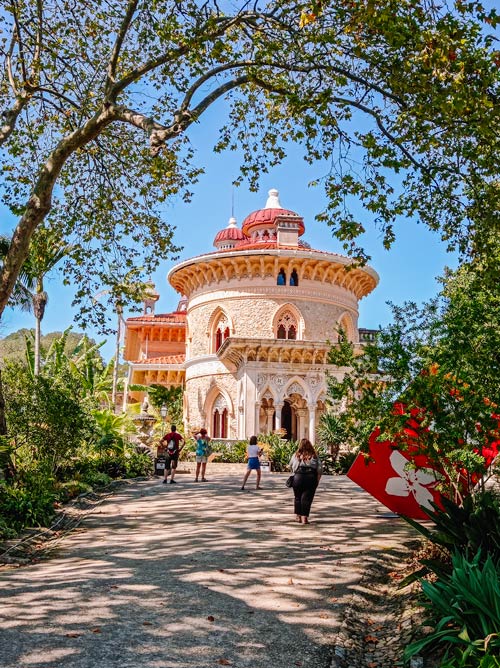
Montserrate Palace, Sintra
Another iconic historical building in Sintra is the 19th-century Montserrate Palace, a stunning palatial villa commissioned by Sir Francis Cook, Viscount of Monserrate.
Its mix of Gothic, Indian, and Moorish architectural styles, along with its unique shape, make it stand out, though it’s also known for the landscaped gardens surrounding it.
They boast more than 3,000 exotic species from all over the world and are thoughtfully dotted with fountains, bridges, statues, and other decorative elements that make them a delight to explore. Purchase your ticket here.
Castelo Dos Mouros, Sintra
With an imposing location overlooking Sintra, it’s no wonder that the 8th-century Castelo dos Mouros played an important military role in the conquest of the area (from the Moors) by the Christians in the 12th century.
Over the years, it underwent many remodelings but was also abandoned for quite some time and damaged by the 1755 earthquake.
The ruinous castle that you get to see today is standing thanks to King Ferdinand II, who decided to restore and preserve it in the 19th century.
A Sintra itinerary is not complete without a visit to the historical Castelo dos Mouros, which also offers some of the most incredible panoramic views over the region. Get your ticket here.

Castle of Santa Maria Da Feira
Showcasing one of the finest examples of Portuguese medieval military architecture, the fairytale-like Castle of Santa Maria da Feira is a landmark you can’t miss.
It’s not exactly known when the castle was built (some say it dates back to the 9th century, while others claim it was built during Roman times), though it already existed when Count D. Henrique ruled the region in the 11th century.
It was remodeled throughout the years and functioned as a fortress, political center, and even a palace, playing an important role in the independence of Portugal.
Quinta Da Regaleira, Sintra
If Sintra hasn’t impressed you yet, maybe Quinta da Regaleira will get the job done.
This 20th-century luxurious estate seems to be taken straight out of a storybook (that has a touch of mystery), with its Gothic facade and a park packed with intriguing elements. Those include hidden passageways, wells with bewitched-looking spiral staircases, quirky statues, and much more.
Commissioned by Brazilian-Portuguese millionaire António Augusto Carvalho Monteiro, the palatial villa reflects his wildest fantasies and interests, so if you want to step into an unusual yet enchanting world, this is a place you shouldn’t miss.

Castle of Leiria
By Jonny from Backpackingman
Castelo de Leiria is one of the best castles in Portugal that you can visit and is scenically located on a hill overlooking the historic city of Leiria.
If you have an interest in some of the history of Portugal, especially castles and medieval architecture, then Castelo de Leiria should be one of the places you visit.
The castle dates to the 12th century and played an important part in the defense of the region. Over the centuries since first being built, it has had some features added to it, such as the Tower of Menagem.
The castle is around a one and a half drive from Lisbon or around two hours from Porto. There’s a good little cafe near it called Arquicafe, which is great for a bite to eat or a drink to relax after seeing the castle.

Beja Castle
By Cath from Wales with Kids
Located in the Alentejo region of Portugal is Beja Castle, a medieval castle in the town of the same name.
The site dates from the 4th century when the Romans were in the city, and the castle has evolved since then to become the structure we see today.
It is not a very large castle but does have some spectacular views across the Alentejo landscape, affording previous residents easy sight of incoming enemy attacks.
Visitors to Beja Castle can enjoy walks along the battlements, climb to the top of the tower keep, and peer inside other buildings as well, such as the Governor’s residence.
The gardens outside of the walls are also a lovely place for a stroll and to admire the castle walls from the exterior. If you are looking for a great landmark to visit in Central Portugal, head to Beja Castle.

Marvão and Its Castle
By Claire from ZigZag On Earth
Marvão is considered one of the most spectacular hilltop villages in Portugal. It offers a great combination of fortification walls, white houses, stone-paved streets, a castle, and stunning surrounding views of the plains.
The hill has been settled since prehistoric times, but the village was founded in the 9th century and the walls were added during the 13th century. It became a vital defensive location during the Middle Ages.
If you happen to be traveling there during the first weekend of October, you can discover it in all its glory. The festival Almossassa fills the white streets with colors and music, to take the visitor to when Marvão was under Muslim control.
Located in the Alentejo region, close to the border with Spain, Marvão is far from Lisbon (2h45 drive), so you cannot take a day trip. But it is a great place to spend a night and enjoy the sunset, sunrise, and a peaceful night!

Monsaraz and Its Castle
By Annie from We Travel Portugal
The village of Monsaraz is a medieval marvel located in the Alentejo region. Perched on the tallest hill in the area, it previously provided a watch over the Alentejo plains and the border with Spain.
Today, it’s a remarkably preserved museum village offering the best of Portugal’s less seen regions. It is surrounded by walls, at one end secured by a 12th-century castle, and at the other, the remains of its 17th-century pointed star fort.
Although the village is small, a stroll through its cobbled streets will lead you to a variety of the region’s long history and culture. Looking out from its walls and in any direction offers you incredible views of the Alentejo countryside.
That countryside is famous for its vineyards, and the terraces of several of Monsaraz’s wine bars are some of the best places to sip and take it all in!

Castle of Almourol
Sitting on a small island in the middle of the Tagus River, the Castle of Almourol is one of the most enchanting castles in Portugal and a symbol of the Portuguese Reconquista.
It’s not entirely clear when the castle was constructed, but it already existed when the area was conquered back from the Moors in the 12th century. It became a stronghold of the Knights Templar, but after their disbandment, the castle was abandoned until the 19th century.
Access to the beautiful castle is by boat from the shore near it or Tancos, but you can also take a Templar-themed day trip from Lisbon.
Buçaco Palace
In comparison to other landmarks in Portugal, the Buçaco Palace might be considered more of a hidden gem, but this little beauty still deserves a spot on this list.
Essentially, it is a 17th-century Discalced Carmelite convent turned into a luxury hotel (though it was almost transformed into a royal residence for Queen Maria Pia).
The Neo-Manueline-style hotel is surrounded by lovely gardens and situated in the heart of the Buçaco Forest, one of the oldest in Europe. If you love unique accommodations, book your stay at the Buçaco Palace!

Read more about traveling in Portugal:
- Road trip from Lisbon to Porto
- Northern Portugal road trip
- Best cities to visit in Portugal
- Best road trips in Portugal
- Hidden gems in Portugal
Famous Landmarks in Portugal: Religious Sites
Sanctuary of Bom Jesus Do Monte, Braga
By Daniela from Daniela Santos Araújo
The Sanctuary of Bom Jesus do Monte is one of the best landmarks in Portugal for its historical, cultural, and architectural value.
Located on a slope overlooking the city of Braga, the site has a special connection to Jerusalem, with its “sacred hill” crowned with a temple.
Although the sanctuary has been reformed since the Middle Ages, its current layout dates back to 1629, with the foundation of the Brotherhood of Bom Jesus do Monte.
This religious association was responsible for funding the construction of the staircases, the chapels depicting the Via Crucis, and the basilica – the first major Portuguese church in Neoclassical style.
The Bom Jesus is one of the most important sanctuaries in Portugal and has been a UNESCO World Heritage Site since 2019.
When you visit, make sure you ride its Elevator (the oldest hydraulic funicular in the world) and wander through its “enchanted” natural park!

Sameiro Sanctuary
Located about 2 km (1.24 miles) from Bom Jesus do Monte, the Sanctuary of Our Lady of Sameiro is one of Portugal’s most visited shrines dedicated to the Virgin Mary.
With an imposing location at 566 meters (about 1857 feet) of altitude, the 19th-century Neoclassical sanctuary offers remarkable views over the city of Braga and its surroundings.
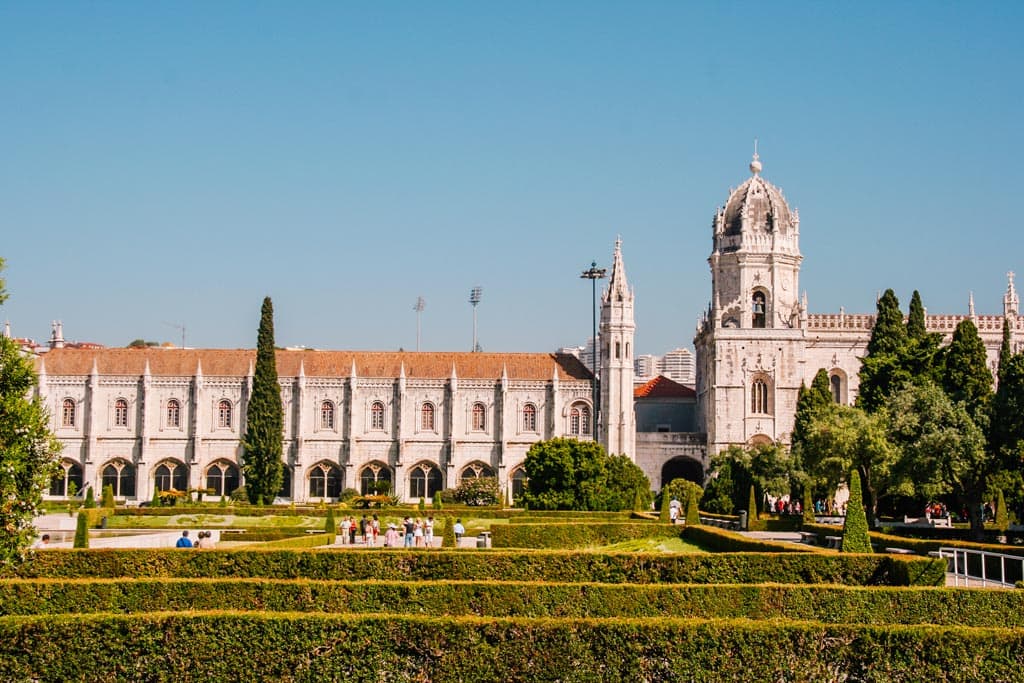
Jeronimos Monastery, Lisbon
If you’re wondering what are the things Lisbon is known for, look no further than the Jeronimos Monastery.
Located in Lisbon’s district of Belem, the UNESCO-listed Jeronimos Monastery is not only a former monastery of the Order of Saint Jerome but also a prominent symbol of Portugal’s Age of Discovery.
The monastery was built on the site of a church where Vasco da Gama had prayed right before his expedition to Asia. It’s his burial place, and its monks also provided spiritual guidance for other aspiring explorers as they set off to discover new lands.
The 16th-century building boasts intricate Manueline-style architectural details from head to toe. Both its beauty and historical significance make it a popular landmark in Portugal and a must-have on any Lisbon itinerary. You can purchase your ticket here.
Sanctuary of Fátima
By Alya from Stingy Nomads
The Sanctuary of Our Lady of Fatima is a remarkable modern religious complex that attracts hundreds of thousands of people every year. Some arrive here on foot following the pilgrimage route of the Camino de Fatima.
It is one of the newest Catholic religious buildings in Europe. The complex was built between 1928 and 1954, but the history of the place dates back to 1916-1917.
Three local shepherd children reported the apparition of an angel. The event soon became well-known, and pilgrims from different parts of Portugal started arriving in Fatima. The place was recognized by the Catholic Church in 1927 when the first religious service took place.
The complex consists of the Basilica of Our Lady of the Rosary, Chapel of the Sacred Lausperene, Chapel of the Apparitions, and several other monuments. The sanctuary is a great example of modern religious architecture.

Convent of Christ, Tomar
The 12th-century Convent of Christ is one of Portugal’s most important UNESCO Sites. The hilltop complex, which was the seat of the Knights Templar and the Knights of the Order of Christ, also includes a Templar castle and its defensive walls.
While Prince Henry the Navigator, one of the biggest symbols of Portugal’s Age of Discovery, was the Grand Master of the Order of Christ, the convent was also a financial resource for his expeditions.
Its historical significance, along with the mix of Romanesque, Gothic, Renaissance, and Manueline architectural styles, make it a place that can transport you to another era, and a trip to Tomar would not be complete without visiting this magical place.

Batalha Monastery
By Maya & Sari from Chasing Lenscapes
There are many impressive man-made landmarks in Portugal, but one of the most stunning spots you can visit on your trip is the beautiful Batalha Monastery.
Located only an hour and a half away from Lisbon, this UNESCO World Heritage Site is considered one of the best examples of medieval Portuguese architecture.
This monastery (which is also known as Mosteiro de Santa Maria da Vitória de Batalha) was built to commemorate the victory of the Portuguese over the Castilians at the Battle of Aljubarrota.
The construction of the monastery took over 100 years, from 1386 to 1517, and several different architects contributed to it, which might explain the mix of Gothic and Manueline styles as well as other influences.
The interior of Batalha Monastery is just as impressive as the exterior, especially the Royal Cloister with its ornate columns, groomed garden, and decorated fountains. Make sure to visit the Unfinished Chapel, which is located in a different part of the monastery.
If you love historical sites and Portuguese architecture, you should definitely add Batalha Monastery to your Central Portugal itinerary. You can get your ticket here.

Alcobaça Monastery
By Inma from A World to Travel
Declared a World Heritage Site by UNESCO, for most visitors, the Alcobaça Monastery is what brings them to the town, which they would otherwise leave aside.
Along with those of Batalha and Tomar, this monastery is an architectural gem from the Gothic period that you need to add to any self-respecting road trip itinerary between Porto and Lisbon.
The austerity and unique light that can be appreciated inside are something that has to be experienced at least once in a lifetime.
Just 120km north of the country’s capital, you can delve into the mysteries that this Catholic monastic complex offers daily between 9 in the morning and 7 in the afternoon.
That said, you should check the schedules before traveling there as they may change depending on the season. And, like most monuments in the country, it usually closes at sunset.

Chapel of the Bones, Evora
By Megan from Packing up the Pieces
Evora is a charming walled city an hour and a half from Lisbon. It boasts one of the more bizarre man-made historical sites in Portugal, a chapel of bones.
Inspired by the bone chapel of San Bernardino alle Ossa, a hidden gem in Milan, it is connected to the Church of St. Francis and was built by monks in the 17th century. They built it as a reminder to the wealthy town that death is inevitable and to not prioritize material things.
Above the entrance, you’ll find the echoing words, “We bones here, for yours await.” The Capela dos Ossos is said to contain over 5,000 human bones that came from the church’s burial grounds.
While most people visit Evora as a day trip, it’s worth it to spend at least one night here.
While the Chapel of the Bones is the town’s main draw, Evora’s cobblestone streets are a delight to wander, especially after the day-trippers return to Lisbon. The city also boasts a unique cuisine unlike any other region in all of Portugal.

Sanctuary of Nossa Senhora Dos Remédios, Lamego
By Izzy & Phil from The Gap Decaders
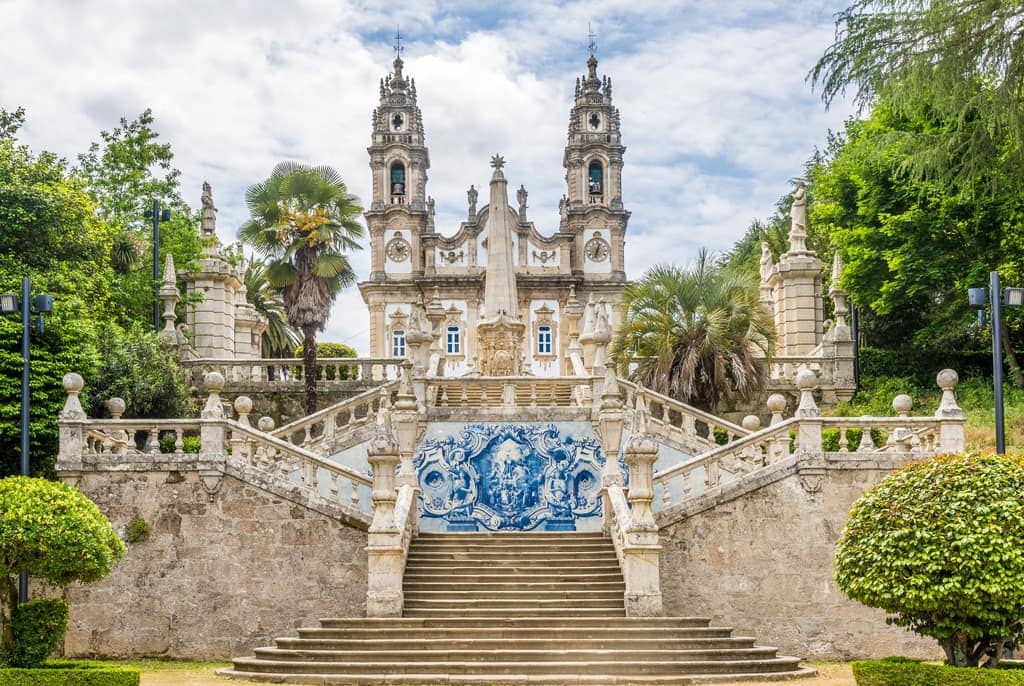
Nestled on the edge of the breathtaking Douro Valley is Lamego, a pretty town famous for the pilgrimage site of the Sanctuary of Nossa Senhora dos Remédios.
Sitting high above the town atop Mount St Stephen, this UNESCO site is a perfect stop on any campervan trip through Portugal.
Built in the 18th century on the site of an old hermitage, the ornate double-towered church and shrine can be reached by climbing a monumental double flight of 691 steps.
This huge Baroque staircase is lined with statues, fountains, and blue and white tiles depicting religious scenes, to spur on pilgrims in the last stage of their journey.
Inside the sanctuary, you’ll find intricate decor, including gilt carved wood, stained glass, and fabulous azulejos (tiles) depicting the life of the Virgin.
Visit on the 8th of September every year, and you can experience the annual pilgrimage procession as locals carry a statue of Our Lady of Remedies up to the church.
Climbing the staircase is an experience not to be missed – the treads worn from years of pilgrims’ feet, the wonderfully typical Portuguese architecture and style, and the surrounding woods all create a vivid impression of religious life in historic Portugal.
If the steps prove too much, you can always drive to the sanctuary at the top!
Carmo Convent, Lisbon
The Carmo Covent is one of the biggest reminders of the 1755 Lisbon earthquake. At that time, the 14th-century building was the city’s largest church, but the devastating event almost completely destroyed it.
Even though it has undergone some repairs over the years, a lot of what you see today belongs to the original structure, so wandering through its medieval ruins is more than a privilege. It even feels magical in a bizarre way, especially when you’re standing under its roofless nave.
The convent is also home to a small archeological museum that has a collection of tombs, mosaics, coins, and other artifacts from different eras in history.

Cristo Rei, Almada
By Sarah & Kris from Jetsetting Fools
One of the most famous monuments in Portugal, visiting the Cristo Rei statue is also one of the top things to see near the city of Lisbon! It took ten years to construct the concrete monument, which was inaugurated in 1959.
The Cristo Rei site has been restored and expanded on several occasions; the complex now includes a chapel, viewing platform, sanctuary, gardens, and galleries.
The 92-foot-tall statue of Christ stands on a 269-foot-tall base, which is nearly as tall as the Christ the Redeemer statue in Rio de Janeiro.
The statue, which is clearly visible from many spots around Lisbon, is truly extraordinary to see up close. It is free to enter the complex, but a ticket is required to ride the elevators to the viewing platform.

Porto Cathedral, Porto
Porto Cathedral is one of the most significant landmarks in Porto’s UNESCO-listed historic center.
It was originally built in the 12th century in Romanesque style and renovated over the years with Baroque and Gothic features added to the building.
The cathedral, easily recognizable thanks to its two square towers, is considered the most important religious building in the city.
It’s also where King João I and Princess Philippa of Lancaster got married in the 14th century and where their son, Prince Henry the Navigator, was baptized.
Visiting the cathedral is free of charge, though accessing the beautiful cloister costs €3.

Blue Churches of Porto
By Victoria from Guide Your Travel
Porto is well known for its blue churches scattered all over the city. They are decorated with beautiful blue and white tiles (called azulejos) on the outside.
However, the most popular ones are the church of Santo Ildefonso, Igreja Do Carmo, and Capela Das Almas, which are all within walking distance from the city center.
These churches from the early 18th century are definitely worth a visit and offer a fantastic photo spot. Make sure to come early after sunrise since a lot of people want to take their perfect holiday picture there.
You can go inside most of these churches to admire their beautiful interior. However, the azulejos are only found on the outside.
When visiting Porto (and these churches), be aware of the pickpockets and scammers who like to rip tourists off.

Lisbon Cathedral
The 12th-century Lisbon Cathedral is a must-see landmark in Portugal, considered the oldest building in Lisbon.
Commissioned by the first king of Portugal, what makes it unique is the mix of different architectural styles and its two towers that give it a look of a medieval fortress.
Also, the cathedral was built on the site of an old mosque, making it a symbol of the reconquest of Lisbon from the Moors.
Monastery of Serra Do Pilar, Vila Nova de Gaia
Across from Porto’s historic center, you’ll find one of its UNESCO World Heritage Site partners, the 16th-century Monastery of Serra do Pilar, known for its circular church and cloister.
It used to belong to the Order of Saint Augustine, but because of its location, it also played an important military role during the Peninsular War and the Siege of Porto in the 19th century.
Beyond the beauty of the Renaissance-style monastery itself, this is also a fantastic spot to enjoy the views of the Duoro River and Porto’s historic center.

Clerigos Church and Tower, Porto
Built for the Brotherhood of the Clérigos in the 18th century, the Clérigos Church and its tower (the tallest bell tower in Portugal) are two of the most notable symbols of Porto.
Clérigos Church was one of the first Baroque churches in Portugal, featuring an oval shape and stunning intricate architectural details. The crowning glory, however, is the tower.
It allows you to marvel at the most incredible panoramic views over Porto, though you need to be prepared – you’ll have to climb more than 200 steps to get to the top (which is totally worth it)! Purchase your ticket here.

Cathedral of Faro
By Paulina from Paulina on the Road
The Cathedral of Faro is situated in the center of Faro’s small Old Town.
According to the traditions, the cathedral is believed to be built over a Paleo-Christian basilica, which was later reconstructed into a mosque during Moorish rule.
It was finally transformed into a Christian church in 1249 by D. Afonso III. The original building experienced major harm in the English raid of 1596 and was then destroyed in the earthquake of 1755.
After that, the cathedral did undergo various renovations by different rulers. You can explore the museum above the church containing various exhibits like religious paintings, vestments, statues, and more.
There is also a pleasant cafe at the location where you can enjoy the tranquil view of the city, which is even more impressive during winter in the Algarve when fewer tourists are in Faro.
Do you like this post about Portugal’s famous landmarks and monuments? Read:
These beautiful places are also the reason why Portugal is your ideal girls’ trip destination in Europe!
Other Famous Portuguese Landmarks
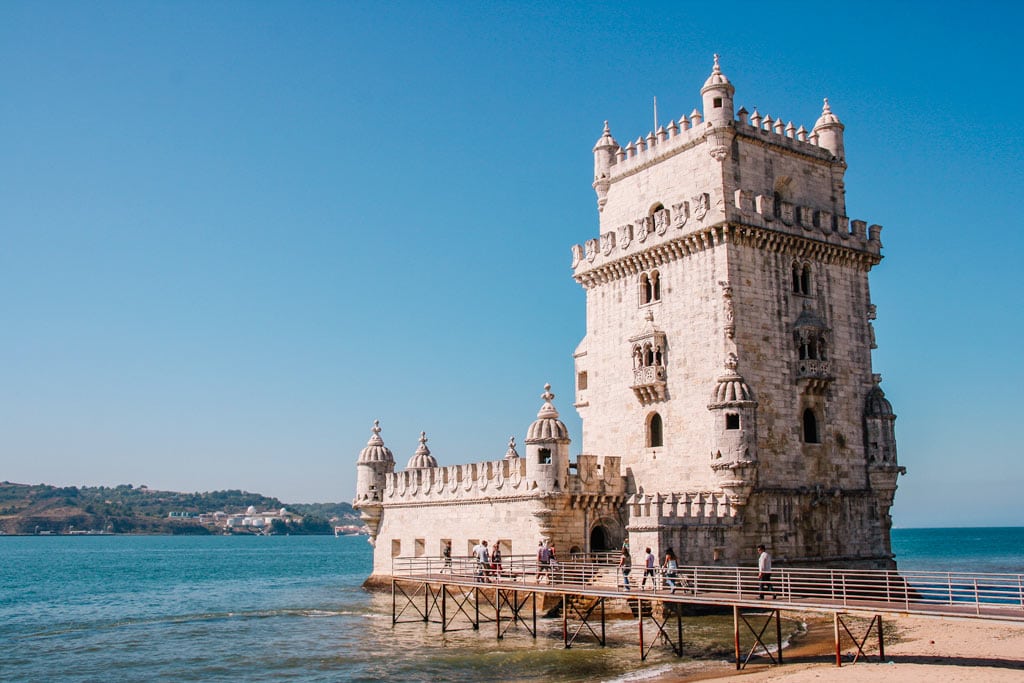
Belem Tower, Lisbon
The Jeronimos Monastery shares its World Heritage Site status with the Belem Tower, a 16th-century Manueline-style fortification.
Built to protect the city after the Portuguese discoveries turned it into a major trade hub, it is one of Lisbon’s most striking symbols, sitting on the banks of the Tagus River. As more sailors had gone on journeys to discover new lands, the tower also marked their embarkation point.
It’s impossible to imagine the skyline of the Portuguese capital without the photogenic Belem Tower, which is one of the biggest reasons many people dedicate an entire day to exploring Lisbon’s Belem district.
Monument to the Discoveries, Lisbon
Not too far from the Belem Tower, you’ll find the Monument to the Discoveries, one of the top free places to visit in Lisbon and a remarkable landmark dedicated to the Portuguese discoveries, built in the middle of the 20th century.
With more than 50 meters in height, it portrays a huge ship featuring 30+ figures connected to that era, including Vasco da Gama, Henry the Navigator, and King Afonso V.
Alongside it, the impressive square depicting a compass rose and a Mappa Mundi is also worth admiring.

Dom Luis I Bridge, Porto
Porto’s historic center and the Monastery of Serra do Pilar share their UNESCO World Heritage Site status with the 19th-century Dom Luís I Bridge.
Designed by Théophile Seyrig, a disciple of Gustave Eiffel (hence the similarity to the Parisian tower), the double-deck metal bridge spans the Douro River and connects Porto with the city of Vila Nova de Gaia, the queen of Port wine cellars.
At the time of its construction, it also held the record of having the longest arch in the world.
To enjoy this Portuguese landmark to the fullest, head to the upper deck. It is used by Porto’s Metro but also has a passageway for pedestrians where you can admire the views.

Crystal Palace Gardens, Porto
By Kat from Wandering Bird
If you’re heading to Portugal and going anywhere near Porto, you must add the Jardins do Palacio de Cristal (Crystal Palace Gardens) to your itinerary.
These breathtaking gardens were actually designed around a palace built in 1865, but it has been replaced by a modern dome/pavilion which is used for sport.
However, the gardens survive and thrive, boasting incredible views over the River Duoro and the city of Porto.
The gardens are on a hilltop but are fairly easy to walk around – there are plenty of paved paths and twisty passages for you to explore.
The 8 hectares include fountains, sculptures, and beautiful flowers – it sometimes feels like several gardens put together, as the areas have totally different ambiances.
Even better, it’s open all year (opening times vary) and is free to enjoy. There’s plenty of parking, even for larger vehicles if you’re campervanning in Portugal

Sagres Fortress
By Cath from Moving to Portugal
Sagres Fortress, located in the southwestern part of the Algarve, is a must-visit sight in Portugal.
The fortress was built in the 16th century to protect the town from North African raiders, and it was from Sagres Fortress that Henry the Navigator devised his 15th-century expeditions. This was the start of the Age of Discoveries in Portuguese history.
The fortress is a large compound that is separated from the mainland by a wall. Within, you will find a lighthouse, a giant wind compass, and a chapel. Many of the buildings were damaged during the great earthquake of 1755 but have been restored.
As well as exploring the fortress grounds, you can enjoy views of the Algarve shore and the jagged cliffs that are indicative of this part of the southern coastline. It is only a few euros to enter and is worth it.

University of Coimbra
It might sound strange that a university is such a must-visit landmark, but since the University of Coimbra is one of the oldest in Europe, it has become a popular tourist attraction.
Established in the 13th century by King Dinis, the UNESCO-listed university changed locations a few times between Lisbon and Coimbra until it permanently settled in the city in the 16th century.
Amongst the university’s must-see points of interest, you’ll find the 18th-century Joanine Library, Chapel of St. Michael, and the University Tower, but there’s so much more to discover here that you have to take a guided tour to fully learn about it.
Bacalhôa Buddha Eden
By Cath from Passports and Adventures
A great man-made landmark to visit in Portugal is Bacalhôa Buddha Eden. Located just an hour north of Lisbon, near the town of Bombarral, this tranquil haven is a surprise lurking in the Portuguese countryside.
Bacalhôa Buddha Eden is a large complex that is an Asian peace garden with a lake, beautifully landscaped gardens, and Buddha statues as far as the eye can see.
From small figures to a huge reclining Buddha with a golden face, the centerpiece of the gardens, there are hundreds of statues to enjoy.
There is also a large, blue ‘Terracotta Army’, tranquil walkways among the trees, babbling brooks, and more for visitors to enjoy.
Bacalhôa Buddha Eden is somewhere you will most likely have never heard of but is a must if you’re visiting the medieval walled town of Obidos during a road trip in Portugal with kids, or as a day trip from Lisbon.

São Bento Railway Station, Porto
By Kenny from Knycx Journeying
Porto has a rich Portuguese culture and vibrant food and wine scene.
But one more thing that you should do is look for the beautiful Azulejos that could be found in churches, palaces, schools, and important buildings in the city. They are painted tin-glazed ceramic tiles, which are usually blue, depicting stories of critical events.
São Bento railway station is one of the most popular landmarks in Porto. Opened in 1916, the station is designed by local artist Jorge Colaço. It is functioning today as the main terminus of Porto’s suburban railway lines to the Douro Valley, Pocinho, and Lisbon.
The entrance hall of the station is decorated by large panels of Azulejos, including King John I and Philippa of Lancaster arriving in Porto, and Prince Henry the Navigator in the conquest of Septa. The station is constantly voted one of the most beautiful in the world.

Lello Bookstore
By Pedro from Travel with Pedro
Amongst all the wonders of Porto, there is one place visitors should not miss. Opened in 1906, Livraria Lello (or Lello Bookstore) always ranks among the most beautiful bookstores in the world.
Starting with its impressive neo-gothic façade, this bookstore attracts people looking for the latest book titles, as well as a cool shot for their Instagram.
The interior has beautiful gothic-inspired wooden shelves, a stained-glass skylight, and an imposing grand staircase.
Due to the large number of tourists that crowded the bookstore, inconveniencing real customers, they started charging an entry fee, which currently, is €5 per person. Lello Bookstore is located at 144 Carmelitas Street, close to some of the best Porto hotels.
Over the years, the bookstore attracted many avid readers and writers. It is said that J.K. Rowling, who was an English teacher in the city in the early 90s, got some inspiration to create Hogwarts at Lello.
Bonus: Benagil Cave
After so many incredible manmade landmarks in Portugal, let’s finish off with the infamous natural sight – the Benagil sea cave.
Located along the Algarve coastline and formed by the waves of the Atlantic Ocean, the beautiful cave boasts a natural skylight and its own little beach, making it one of the most picture-perfect spots in southern Portugal.
To visit it, you’ll have to book one of the many boat tours offered in the area.
Map
Click here to see the My Maps interactive map of Portugal’s landmarks.
Tip: After accessing the map, you can also open it on your Google Maps app. Simply open your app, tap the ‘saved’ icon at the bottom, scroll down and tap the ‘maps’ icon, and choose the MyMaps map you want to see (you can do the same on your computer).
Pin this roundup of famous Portugal landmarks for later using the share icon on the right bottom corner!

*Your emil address will not be published. By using this form you agree with the storage and handling of your data by this website