
Traveling to Italy in the shoulder season definitely has pros and cons, so I understand why it’s a bit challenging to determine if it’s worth visiting Puglia in March.
I myself wasn’t entirely sure what to expect, especially as a first-time visitor to this lovely region in Southern Italy, but I decided to book that trip anyway, so here’s what I have to say about it.
*I try to keep the information on this blog as updated as possible, but I still recommend consulting the latest prices, opening hours, and other details on the official website of each site, hotel, and tour, as well as checking the updated public transport routes and timetables. I share my personal experience and cannot guarantee yours.
*This post may contain affiliate links from which I earn a commission. As an Amazon Associate, I earn from qualifying purchases. For more info, read my disclosure and disclaimer. This post may show pop-ups.
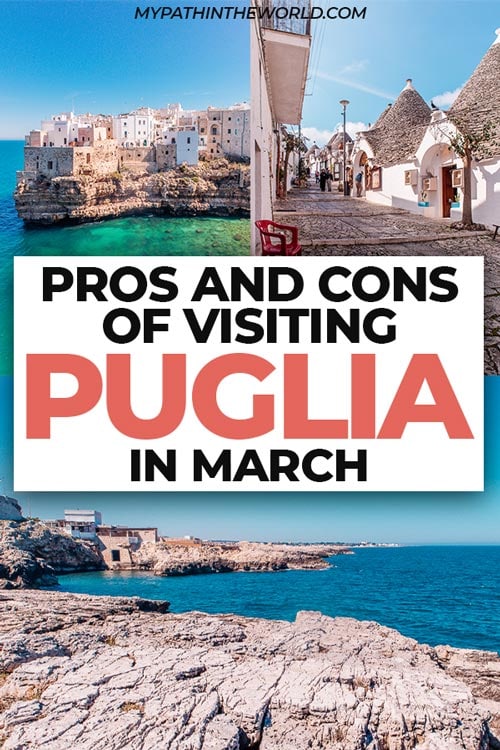
Weather in March in Puglia
If you’re wondering how warm it is, I’ll say it depends on when exactly you’re visiting because every day can be different.
Various sources show different statistics when it comes to rain, though most of them talk about 7-10 rainy days.
At the beginning of the month, the average temperatures are 8C°-12C° (46.4°F-53.6°F) by day and 3C°-6C° (37.4°F-42.8°F) by night, but at the end of it, they reach 17C°-22C° (62.6°F-71.6°F) by day and 6C°-9C° (42.8°F-48.2°F) by night.

As for my own experience, I visited Puglia in the second half of March, and although the initial forecast was all over the place (and it was constantly changing), I got to enjoy pretty perfect weather.
Apart from one rainy morning, most days were extremely sunny, some with a light cold breeze and others very warm. The water was still too chilly for a swim, though I did see some of the locals sunbathing and even taking a dip.
The evenings were not too cold either, as the lowest temperatures kicked in only in the middle of the night.

Pros of Visiting Puglia in March
Sunny Days
When the sky is clear and the sun comes out, yet it’s not as hot and humid as it is in the summer, it’s an absolute delight to explore Puglia.
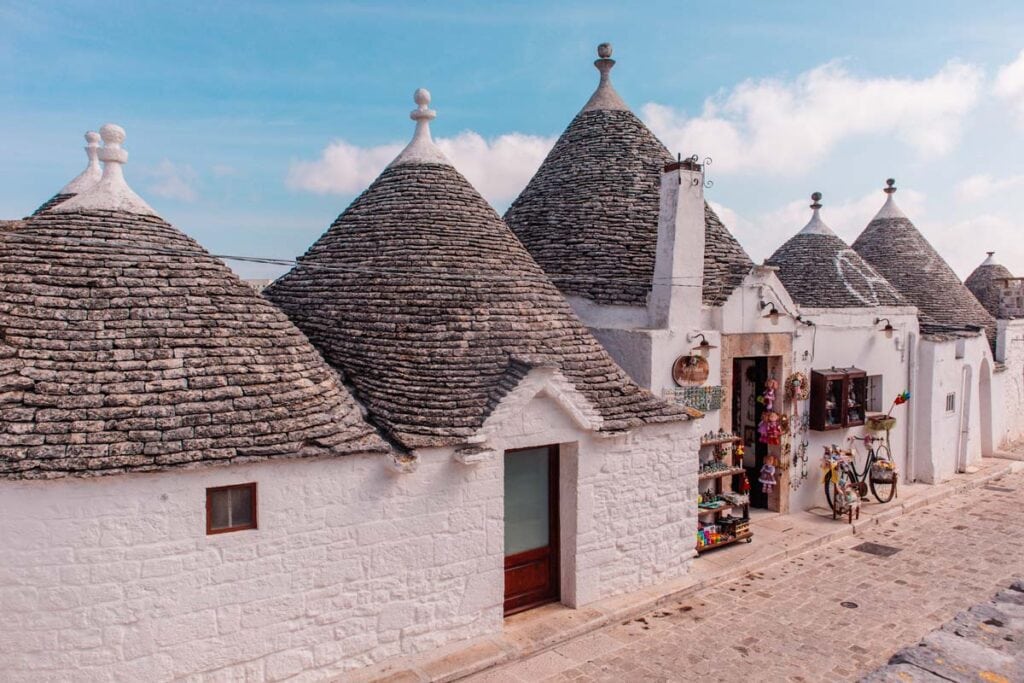
Many activities in this southern Italian region are open-air, from appreciating its coastal views (and even taking boat tours) to visiting archaeological sites to roaming its countless enchanting inland or coastal towns and cities like Bari, Polignano a Mare, Monopoli, and Alberobello.
Few Crowds
As an introvert and a highly sensitive person, I’m often looking for serenity, and I choose to either visit underrated regions or explore the more touristy ones off-season, so visiting Puglia at this time of the year was ideal in that aspect.
Having the longest coastline in mainland Italy and some of the best beaches in the country means that Puglia is a popular summer destination, yet in March, you’ll have it almost completely to yourself.
I’m sure you’ve seen countless photos of Alberobello’s quirky Trulli houses, a UNESCO World Heritage Site, or Polignano a Mare’s scenic yet crowded beach, Lama Monachile, so relishing these spots without having a lot of people around you is a real privilege.


Low Prices
I also considered visiting Puglia in the summer, and I have to say that it is very much possible to plan a budget-friendly trip even in July and August (with or without a car), with more than enough cities and towns offering accommodations for every price range.
That said, the shoulder season will reward you with incredible flight and hotel prices, even in popular coastal towns and cities like Bari and Polignano a Mare, where it’s possible to book a double room at a highly-rated accommodation (9+) for less than 70 euros per night in March.
In smaller villages, you can easily find highly-rated (9+) apartments or B&Bs that charge as little as 40 euros per night for a double room.

Cons of Visiting Puglia in March
Not an Ideal Time for a Beach Vacation
While there’s a very good chance to have some sunny days in March, if you’re thinking of a beach vacation, I don’t think the water is warm enough to go for a proper swim.
Even if you just want to soak up the sun, I can’t guarantee that you’ll feel like it’s hot enough to sit on the beach wearing only a bathing suit (I’ve seen the locals do that, but I needed a sweater).
That said, you can still enjoy sitting on the shore, listening to the sound of the waves, and appreciating the beauty of the mesmerizing shades of blue.

Possible Rainy Days
You can definitely engage in some indoor activities, like:
- Visiting museums in Puglia, including the Pinacoteca Metropolitana di Bari, Museum of Primitivo Wine, and Trullo Sovrano
- Touring religious sites and castles such as Castello Svevo di Bari
- Taking cooking classes
- Stuffing your face with delicious orecchiette pasta and other local dishes at typical Apulian restaurants
But it wouldn’t be fun to spend your whole trip escaping the rain.
It feels impossible to enjoy Puglia to the fullest without strolling through the streets and alleys of its towns or relaxing on the beach (even without swimming), nor would that be enjoyable to do when it rains.
So take the weather into consideration, whether it’s in planning a trip in late March instead of the beginning or having a backup itinerary plan for rainy days.

Other Things to Consider
Some Businesses Are Closed
With so few tourists, many restaurants, cafes, shops, and touristic services across the region are not open in March.
Bari, the lively Apulian capital, is a big exception, so if you’re only craving a short weekend break in this city, this isn’t an issue at all. Throughout the week, you’ll see the locals enjoying an aperivito with friends in the many restaurants and bars, the shopping streets in the Murat district are bustling, and even the promenade is full of life.
But in a couple of other towns I visited (like Polignano or Trani, a real hidden gem in Puglia), the selection of places to eat was quite limited because most were closed.
On the other hand, there’s a large variery of accommodations to choose from, countless tour providers do operate in March, and car rental companies and public transport are always available, so you won’t be limited in those aspects.

Is Puglia Worth Visiting in March? The Verdict
The main issue is that you can’t really tell in advance what the weather will be like as it can be different each day in a month like March, and the forecast keeps changing.
I still think it’s worth taking that risk because that combo of pleasant early spring weather, low prices, and no tourists is fantastic, but try to plan your trip at the end of March, so there’s a better chance for non-rainy days.

Things to Do
Here are a few guides to help you plan your trip:
- 5 days in Puglia without renting a car
- Best things to do in Bari
- 2 days in Bari
- Day trips from Bari
- Where to stay in Bari
- Reasons to visit Bari

What to Pack
Considering every possible temperature, it’s best to pack some light sweaters long-sleeve shirts, one or two warmer sweaters, and a mid-weight puffer jacket for the colder days. Bring short-sleeve t-shirts for the warmer days or layering.
Add a couple of jeans and sneakers, and you’re good to go.
“Puglia Without a Car” Digital Guide
Shop My “Puglia Without a Car” Digital Guide
- Save time on creating your trip map from scratch and figuring out the logistics
- Plan your trip more easily without getting overwhelmed
- Make the most of your time in Puglia according to your travel pace and preferences
You’ll get:
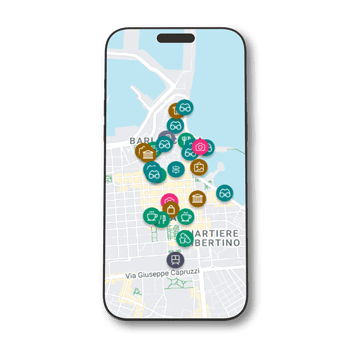
- A map with 150+ spots I liked in the towns I visited on my car-free trips (with info and personal notes)
- Super detailed practical guides for planning a car-free trip more easily (where to stay, getting around, optional itineraries, and more)
- A useful itinerary builder
- Lifetime access including updates

went to Puglia region begining of May last year temperatures were ok around an average of 19/20 degrees with the odd shower. Nowhere was over crowded with welcoming locals. Such a beautiful area something great to see or do whatever the weather well worth a visit.
That’s great to know – I’m considering going back this May! Thanks, Russell!